Download Professional Scrum Master II.PSM-II.Actual4Test.2026-11-10.81q.vcex
| Vendor: | Scrum |
| Exam Code: | PSM-II |
| Exam Name: | Professional Scrum Master II |
| Date: | Nov 10, 2026 |
| File Size: | 304 KB |
How to open VCEX files?
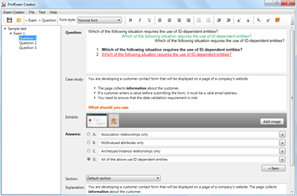
Files with VCEX extension can be opened by ProfExam Simulator.
Discount: 20%



Demo Questions
Question 1
Your organization has announced a release to its user base three Sprints from now To be able to include all functionality in the release, work needs to accelerate. The Product Owner puts some testing from the Definition of Done on hold for the next three Sprints, while adding a generic item to the Product Backlog to resolve this in a future release. The Developers object that this will lead to technical debt. Select two ways that explain the impact of technical debt to the Product Owner.
(Choose the best two answers)
- Feature development of a next release is not allowed to start as long as there is technical debt from the current release. The Product Owner should first accept this impact before the Definition of Done can be reduced.
- A generic Product Backlog item is not good enough. The amount of technical debt will have to be calculated and estimated much more precisely, so the total amount of extra work that needs to be budgeted is well known.
- Releasing the version creates false assumptions about the actual state of the system. This is likely to result in interruptions during future Sprints in order to react to unforeseen problems arising from not having met the Definition of Done.
- As development progresses and functionality is added upon the reduced Definition of Done, unknown errors will creep in. The system becomes more difficult to stabilize. Work for the actual release as well as future releases Will be slowed down in unpredictable ways.
Correct answer: C, D
Explanation:
Technical debt is the implied cost of rework caused by choosing an easy solution now instead of a better approach that would take longer. Reducing the Definition of Done for the next three Sprints will create technical debt, which will have negative impacts on the product quality, value, and delivery. Two ways to explain these impacts to the Product Owner are:Releasing the version creates false assumptions about the actual state of the system. This is likely to result in interruptions during future Sprints in order to react to unforeseen problems arising from not having met the Definition of Done. This will reduce the transparency, predictability, and adaptability of the Scrum process, and compromise the trust and satisfaction of the customers and stakeholders. As development progresses and functionality is added upon the reduced Definition of Done, unknown errors will creep in. The system becomes more difficult to stabilize. Work for the actual release as well as future releases will be slowed down in unpredictable ways. This will increase the complexity, risk, and cost of the product development, and lower the value and quality of the product.
Question 2
At the end of the eighth Sprint, the internal sponsors are upset and angry with the progress of the product being built. The current state of the product is not as expected and will require additional Sprints and more budget than originally anticipated at the start of the project.
What factors may have led to this? (Choose three.)
- The Product Owner has not been engaging with sponsors frequently enough and has not been kept aware of the overall progress of the project.
- The sponsors haven't been using the Sprint Reviews to actively engage, and inspect and evaluate progress.
- The scope changes have not been tracked adequately and the change request process has not been followed properly.
- The stakeholders have not been using the Daily Scrum effectively to track the Development Team's progress.
- The Scrum Master has not ensured transparency.
- The project plan proposed to the sponsors at the start of the project followed stringently.
Correct answer: A, B, E
Explanation:
One of the principles of agility includes working closely with business people. In order to manage stakeholder expectation, there must be open communication (through collaboration and transparency) throughout the project cycle. This maximizes alignment, helps with making business decisions, and reduces risk.Although, the Scrum Guide does not directly state that the Scrum Master is responsible for ensuring transparency it is implicit. The Scrum Master is responsible for the process in which Scrum is adopted and enacted. Scrum is founded on empiricism and the Scrum Master helps those inside and outside the team work in an empirical environment which includes transparency (one of the three pillars of empiricism).
Question 3
A Scrum Team has requested a hardening Sprint to integrate the work produced in previous Sprints and test before releasing.
What three scenarios has likely occurred? (Choose three.)
- The team's Definition of Done is not being adhered to during every Sprint.
- The team's Definition of Done is weak or incomplete causing a build up of technical debt.
- The Development Team is having difficulties with the ability to regularly release during a Sprint.
- Hardening Sprints are supported by the Scrum framework so this is acceptable.
- Scrum has been customized in a suitable manner to make the previous work releasable.
Correct answer: A, B, C
Explanation:
At the end of a Sprint, the new Increment must be `Done', which means it must be in useable condition and meet the Scrum Team's Definition of Done.
Question 4
An organization has just hired you as a new Scrum Master to help them transition their teams from their current traditional process to Scrum. The teams are currently structured to specialize in a single function. This is also known as component teams where a team would only address a single layer (i.e. design, frontend, backend, database, testing, etc.). You've introduced the concept of cross-functional teams where all the skills needed to produce business functionality, from end to end, are inside of a single team.
What should you keep in mind when transitioning from siloed teams to cross-functional teams?
(Choose two.)
- It is easier to compare the performance between cross-functional teams in order to identify to which teams to assign tasks and which teams need additional coaching.
- Newly formed teams will need time to stabilize before reaching their peak performance. During the initial stages of forming, performance will suffer and productivity may be low, although even then delivery of business value is still likely to increase.
- Without feature teams, you cannot do Scrum. Postpone Scrum adoption until the teams are reorganized in feature teams.
- People from the different layers and components will need time to become accustomed to working and delivering unified functionality together as one Scrum Team thus productivity may suffer.
Correct answer: B, D
Explanation:
Forming a team takes time, and members often go through recognizable stages as they change from being a collection of strangers to a united group with common goals. Bruce Tuckman's Forming, Storming, Norming, and Performing model describes these stages. When you understand it, you can help your new team become effective more quickly.
Question 5
How much time should be spent carrying out Product Backlog Refinement?
- Up to 10% of the capacity of the Development Team in a typical Sprint, but as much as 90% in early Sprints
- As much as the Product Owner deems necessary to create enough ready Product Backlog Items
- No more than 10% of the capacity of the Development Team
- As much as the Product Owner and Development Team agree is necessary to create enough ready Product Backlog Items
Correct answer: D
Question 6
A new member has just joined an existing Development Team that has been together for several Sprints. During the Sprint, the individual has been trying to share his ideas and viewpoints but is continuously ignored by the rest of the Development Team.
Which three Scrum Values has the Development Team been neglecting? (Choose three.)
- Commitment
- Respect
- Transparency
- Focus
- Openness
- Courage
Correct answer: B, E, F
Explanation:
The Scrum Team members have courage to do the right thing and work on challenging problems. The Scrum Team agree to be open (to speak and listen) about all the work and the challenges with performing the work. Scrum Team members respect each other's skills, experience, and opinions.
Question 7
Which two statements best describe a Sprint Goal? (Choose two.)
- Sprint Goals are defined when the completed work is reviewed at the end of a Sprint.
- Sprint Goals give the Development Teams flexibility and creativity on how to implement functionality during the Sprint.
- During the Sprint Planning, the entire Scrum Team collaboratively crafts a Sprint Goal based on a business objective that the Product Owner would like to achieve that Sprint.
- Sprint Goals can change as new insights emerge during the Sprint.
Correct answer: B, C
Explanation:
The number of items selected from the Product Backlog for the Sprint is solely up to the Development Team.Only the Development Team can assess what it can accomplish over the upcoming Sprint.The Sprint Goal is an objective set for the Sprint that can be met through the implementation of Product Backlog. It provides guidance to the Development Team on why it is building the Increment. It is created during the Sprint Planning meeting. The Sprint Goal gives the Development Team some flexibility regarding the functionality implemented within the Sprint. The selected Product Backlog items deliver one coherent function, which can be the Sprint Goal. The Sprint Goal can be any other coherence that causes the Development Team to work together rather than on separate initiatives.
Question 8
At the ninth Sprint Retrospective, the Product Owner is very disappointed and angry. She has determined that the technical debt has increased, and the product is not meeting her expectations. The product will need a few more Sprints to meet the scalability requirements.
Which of the following could be true? Select the best response. (Choose the best answer)
- The Scrum Team is not having conversations around technical debt.
- None of the above.
- The Scrum Team has not used the past Sprint Retrospectives effectively to inspect and adapt.
- The Scrum Master has not ensured that the Scrum Team is being transparent.
- All of the above.
- The Developers have not been paying enough attention to quality.
Correct answer: E
Question 9
You are a Scrum Master helping to establish five Scrum Teams that will be building a product.
You discuss with them the high level of integration that the product Increment will require by the end of their first Sprint. It is a highly anticipated product, both by consumers and by the organization. Of the options raised by the future Scrum Team members, which option do you encourage? (Choose the best answer)
- Each Scrum Team provides a separate Increment with the functionality added by the individual team. The Sprint Review is used to identify the work needed to integrate with the other Scrum Teams. This work is then added to the Product Backlog.
- Each Scrum Team delivers done Increments in its own area of responsibility. Upon functional acceptance at the Sprint Review, the code is isolated for future stabilization. The release date is adjusted according to the expected work and time of such integration phase.
- In the first Sprint, integration is less important. The goal is to deliver business value. Functionality that is not integrated with the work of other Scrum Teams by the end of a Sprint is still reviewed to assess its potential business value. It can still be released at the Product Owner's discretion, and silent consent of the stakeholders.
- All Scrum Teams agree on a shared Definition of Done that describes all work needed to deliver an Increment that is the integrated sum of the work from all Scrum Teams.
Correct answer: D
Explanation:
The Scrum Guide states that "the moment a Product Backlog item meets the Definition of Done, an Increment is born" and that "the Increment is the sum of all the Product Backlog items completed during a Sprint and the value of the increments of all previous Sprints". Therefore, to deliver a product Increment that is integrated and potentially releasable, all Scrum Teams must have a shared understanding of what "Done" means and ensure that their work meets that standard. This also enables transparency, inspection, and adaptation across the Scrum Teams.
Question 10
What does the Scrum Team commit to each Sprint?
(choose the best three answers)
- Getting all the forecast work in the Sprint Plan done
- Increasing velocity
- Working towards the Sprint Goal.
- Seeking stakeholder feedback.
- Having the Product Owner available to the Developers on a daily basis
- Upholding transparency
Correct answer: C, D, F
Explanation:
ExplanationAccording to the Scrum Guide 2020, the Scrum Team commits to achieving the Sprint Goal and creating a valuable product Increment every Sprint1. The Sprint Goal is a short statement that provides direction and focus for the Scrum Team throughout the Sprint2. The product Increment is a concrete and usable outcome that meets the Definition of Done and adds value to the product3. Therefore, the Scrum Team commits to:Working towards the Sprint Goal. This means that the Scrum Team collaborates and coordinates their work to deliver a product Increment that satisfies the Sprint Goal. The Sprint Goal is chosen by the Scrum Team during Sprint Planning, based on the Product Backlog items that they forecast to complete in the Sprint2. The Sprint Goal provides coherence and alignment for the Scrum Team, and helps them cope with complexity and uncertainty4.Seeking stakeholder feedback. This means that the Scrum Team engages with the stakeholders and customers who have an interest or influence on the product. The Scrum Team seeks their feedback to inspect and adapt the product Increment and the Product Backlog, and to validate their assumptions and hypotheses. The Sprint Review is an event where the Scrum Team and the stakeholders collaborate on what was done in the Sprint and what to do next.Upholding transparency. This means that the Scrum Team makes all aspects of their work visible to those who are responsible for the outcome. Transparency enables inspection and adaptation, which are essential for empiricism. The Scrum Team upholds transparency by using the Scrum artifacts (Product Backlog, Sprint Backlog, and Increment) as sources of information and progress, and by having frequent and honest communication among themselves and with the stakeholders.The other options are not correct because:Getting all the forecast work in the Sprint Plan done. This option is incorrect because it implies that the Scrum Team is committed to a fixed scope of work, rather than a flexible goal. The Scrum Guide 2020 states that "the Developers do not commit to completing all of the work planned during a Sprint Planning" but rather "they plan their work as they perform it throughout the Sprint". The Scrum Team can modify their Sprint Backlog during the Sprint as needed, as long as they do not endanger the Sprint Goal.Increasing velocity. This option is incorrect because it implies that the Scrum Team is committed to a metric that is not part of the Scrum framework. Velocity is a measure of how much work a team can deliver in a given time period, usually based on story points or hours. However, velocity is not a reliable indicator of value or quality, and it can vary depending on many factors, such as team size, complexity, dependencies, etc. The Scrum Guide 2020 does not mention velocity as a commitment or an artifact of the Scrum Team.Having the Product Owner available to the Developers on a daily basis. This option is incorrect because it implies that the Product Owner is not part of the Scrum Team, but rather an external stakeholder. The Scrum Guide 2020 states that "the Product Owner is one person who is a member of the Scrum Team" and "is accountable for maximizing value resulting from work of Developers". The Product Owner collaborates closely with the Developers throughout the Sprint, not only by being available, but also by providing vision, guidance, feedback, and clarification.References: 1: https://www.scrumguides.org/scrum-guide.html#team-accountabilities 2:https://www.scrumguides.org/scrum-guide.html#sprint-goal 3:https://www.scrumguides.org/scrum-guide.html#increment 4:https://www.scrum.org/resources/blog/sprint-goal-key-element-scrum :https://www.scrum.org/resources/blog/stakeholder-engagement-scrum :https://www.scrumguides.org/scrum-guide.html#sprint-review :https://www.scrumguides.org/scrum-guide.html#scrum-theory :https://www.scrumguides.org/scrum-guide.html#sprint-planning :https://www.scrumguides.org/scrum-guide.html#sprint-backlog :https://www.scrum.org/resources/blog/velocity-trap :https://www.scrumguides.org/scrum-guide.html#product-owner
HOW TO OPEN VCE FILES
Use VCE Exam Simulator to open VCE files
HOW TO OPEN VCEX AND EXAM FILES
Use ProfExam Simulator to open VCEX and EXAM files
ProfExam at a 20% markdown
You have the opportunity to purchase ProfExam at a 20% reduced price
Get Now!