Download SAP Certified Associate - Back-End Developer - ABAP Cloud.C_ABAPD_2507.Pass4Success.2026-01-27.14q.vcex
| Vendor: | SAP |
| Exam Code: | C_ABAPD_2507 |
| Exam Name: | SAP Certified Associate - Back-End Developer - ABAP Cloud |
| Date: | Jan 27, 2026 |
| File Size: | 19 KB |
How to open VCEX files?
Files with VCEX extension can be opened by ProfExam Simulator.
Discount: 20%

Demo Questions
Question 1
Which language is used to add or change data of a business object in RAP?
- Data manipulation language
- Entity manipulation language
- Data modification language
- RAP editing language
Correct answer: B
Explanation:
In RAP, changes to business object data are performed using Entity Manipulation Language (EML).It provides ABAP statements such as READ ENTITIES, MODIFY ENTITIES, CREATE, and DELETE for RAP BOs.EML is the cloud-compliant equivalent of SQL DML (insert/update/delete) but tailored to RAP's transactional consistency.Verified Study Guide Reference: RAP Programming Model -- Entity Manipulation Language (EML). In RAP, changes to business object data are performed using Entity Manipulation Language (EML).
It provides ABAP statements such as READ ENTITIES, MODIFY ENTITIES, CREATE, and DELETE for RAP BOs.
EML is the cloud-compliant equivalent of SQL DML (insert/update/delete) but tailored to RAP's transactional consistency.
Verified Study Guide Reference: RAP Programming Model -- Entity Manipulation Language (EML).
Question 2
In RESTful Application Programming, a business object contains which parts?
Note: There are 2 correct answers to this question.
- Process definition
- Behavior definition
- CDS view
- Authentication rules
Correct answer: B, C
Explanation:
In the RAP model, a Business Object (BO) is composed of the following key parts:A CDS view, which defines the data model layer (entity structure, projections, associations).A Behavior Definition (BDEF), which defines the behavior layer -- what operations can be performed (create, update, delete, validations, determinations).Therefore:Option B and C are correct.Option A is incorrect because 'Process definition' is not a RAP construct; process logic is handled via behavior implementation and determinations.Option D is incorrect because 'Authentication rules' are managed externally (e.g., via IAM, authorizations), not inside the BO.=========== In the RAP model, a Business Object (BO) is composed of the following key parts:
A CDS view, which defines the data model layer (entity structure, projections, associations).
A Behavior Definition (BDEF), which defines the behavior layer -- what operations can be performed (create, update, delete, validations, determinations).
Therefore:
Option B and C are correct.
Option A is incorrect because 'Process definition' is not a RAP construct; process logic is handled via behavior implementation and determinations.
Option D is incorrect because 'Authentication rules' are managed externally (e.g., via IAM, authorizations), not inside the BO.
===========
Question 3
You have the following CDS definition (aliases shown):
define view entity Z_ENTITY
as select from Z_SOURCE1 as _Source1
association to Z_SOURCE2 as Source2 on ???
{
key carrier_id as Carrier,
key connection_id as Connection,
cityfrom as DepartureCity,
cityto as ArrivalCity,
Source2
}
(The data sources are joined by the field carrier_id. The corresponding field in Z_SOURCE2 is also carrier_id.)
Which ON condition must you insert?
- ON Z_SOURCE1.carrier_id = Z_SOURCE2.carrier_id
- ON $projection.carrier_id = Z_SOURCE2.carrier_id
- ON $projection.Carrier = _Source2.carrier_id
- ON _Source1.carrier_id = Source2.carrier_id
Correct answer: D
Explanation:
In a CDS view entity defined AS SELECT FROM, the association ON condition must use the source aliases defined in the FROM clause.$projection is used in projection views (AS PROJECTION ON ...), not in a basic select view entity. Therefore, options using $projection (B, C) are invalid here.Using global names (Z_SOURCE1, Z_SOURCE2) in the ON (A) ignores the declared aliases and is not the recommended/valid form within the view definition.The correct ON clause uses the aliases _Source1 and Source2 with the matching key fields:ON _Source1.carrier_id = Source2.carrier_id (D).This aligns with CDS modeling rules in RAP: use aliases consistently and model associations with precise ON conditions based on keys.Study Guide Reference: ABAP CDS Development---Associations & ON conditions; RAP Data Modeling. In a CDS view entity defined AS SELECT FROM, the association ON condition must use the source aliases defined in the FROM clause.
$projection is used in projection views (AS PROJECTION ON ...), not in a basic select view entity. Therefore, options using $projection (B, C) are invalid here.
Using global names (Z_SOURCE1, Z_SOURCE2) in the ON (A) ignores the declared aliases and is not the recommended/valid form within the view definition.
The correct ON clause uses the aliases _Source1 and Source2 with the matching key fields:
ON _Source1.carrier_id = Source2.carrier_id (D).
This aligns with CDS modeling rules in RAP: use aliases consistently and model associations with precise ON conditions based on keys.
Study Guide Reference: ABAP CDS Development---Associations & ON conditions; RAP Data Modeling.
Question 4
Which of the following rules apply for dividing with ABAP SQL?
Note: There are 3 correct answers to this question.
- The division operator ''/'' accepts decimal input.
- Numeric function division( numerator, denominator, decimal places ) accepts decimal input.
- Numeric function div( numerator, denominator ) expects only integer input.
- The division operator ''/'' accepts floating point input.
- Numeric function division( numerator, denominator, decimal places ) accepts floating point input.
Correct answer: B, C, E
Explanation:
In ABAP SQL, the handling of arithmetic operations --- especially division --- is handled with care for data types and precision. Here's how each applies:B . Numeric function division(numerator, denominator, decimal places) accepts decimal inputThis is correct. The division function is designed for decimal-based calculations, where precision control is needed via the third parameter (number of decimal places). It supports packed numbers (DEC).C . Numeric function div(numerator, denominator) expects only integer inputThis is correct. The div function is an integer division operator, returning an integer result and only accepts integers as input types.E . Numeric function division(numerator, denominator, decimal places) accepts floating point inputThis is correct. In addition to decimals, division() can also work with floating point types (FLTP), enabling flexible division where decimals are not sufficient.A . The division operator ''/'' accepts decimal inputThis is incorrect in the context of ABAP SQL. The / operator is not available as a built-in operator in Open SQL; arithmetic operations like this are not supported with native operators --- only via functions.D . The division operator ''/'' accepts floating point inputAgain, this is incorrect, as / is not valid syntax in ABAP SQL queries. Only built-in functions like div or division are supported in the CDS/Open SQL layer.ABAP CDS Development Guide, section 2.2 -- Built-in functions in ABAP SQL and CDS expressions for numerical calculations, specifically division() and div(). In ABAP SQL, the handling of arithmetic operations --- especially division --- is handled with care for data types and precision. Here's how each applies:
B . Numeric function division(numerator, denominator, decimal places) accepts decimal input
This is correct. The division function is designed for decimal-based calculations, where precision control is needed via the third parameter (number of decimal places). It supports packed numbers (DEC).
C . Numeric function div(numerator, denominator) expects only integer input
This is correct. The div function is an integer division operator, returning an integer result and only accepts integers as input types.
E . Numeric function division(numerator, denominator, decimal places) accepts floating point input
This is correct. In addition to decimals, division() can also work with floating point types (FLTP), enabling flexible division where decimals are not sufficient.
A . The division operator ''/'' accepts decimal input
This is incorrect in the context of ABAP SQL. The / operator is not available as a built-in operator in Open SQL; arithmetic operations like this are not supported with native operators --- only via functions.
D . The division operator ''/'' accepts floating point input
Again, this is incorrect, as / is not valid syntax in ABAP SQL queries. Only built-in functions like div or division are supported in the CDS/Open SQL layer.
ABAP CDS Development Guide, section 2.2 -- Built-in functions in ABAP SQL and CDS expressions for numerical calculations, specifically division() and div().
Question 5
Which statements apply to the TRY-ENDTRY construct? (Select 3 correct answers)
- A CATCH clause can be used as a handler for several exception classes.
- A CLEANUP clause catches remaining exceptions.
- All matching CATCH clauses are always executed.
- A superclass in a CATCH clause catches exceptions of itself and of its subclasses.
- CATCH clauses should be organized ascending from most specific to most general.
- Valid: Best practice is to order CATCH blocks from most specific most general.Study Guide Reference: ABAP Keyword Documentation -- TRY ... CATCH ... CLEANUP.
Correct answer: A, D, E, E
Explanation:
A . Valid: A CATCH block can list multiple exception classes separated by |.B . Wrong: CLEANUP is not a catch mechanism; it executes after try/catch, regardless of exception, but does not handle exceptions.C . Wrong: Only the first matching CATCH executes, not all.D . Valid: A superclass exception handler can catch its subclasses. A . Valid: A CATCH block can list multiple exception classes separated by |.
B . Wrong: CLEANUP is not a catch mechanism; it executes after try/catch, regardless of exception, but does not handle exceptions.
C . Wrong: Only the first matching CATCH executes, not all.
D . Valid: A superclass exception handler can catch its subclasses.
Question 6
You select a field flight_date with type DATS in the field list of a CDS view.
Which of the following expressions returns the 2-digit month from the field?
(Select 2 correct answers)
- substring( flight_date, 5, 2 )
- right( left( flight_date, 6 ), 2 )
- left( right( flight_date, 6 ), 2 )
- substring( flight_date, 4, 2 )
Correct answer: A, B
Explanation:
A DATS field is stored as YYYYMMDD.Option A: substring( flight_date, 5, 2 ) Extracts characters 5--6 correct month.Option B: right( left( flight_date, 6 ), 2 ) Takes first 6 chars YYYYMM, then last 2 correct month.Option C: Wrong, extracts last 2 chars of MMDD, results in day not month.Option D: Wrong, starts at 4 gives YM instead of MM.Study Guide Reference: ABAP CDS Development Guide -- String Functions in CDS. A DATS field is stored as YYYYMMDD.
Option A: substring( flight_date, 5, 2 ) Extracts characters 5--6 correct month.
Option B: right( left( flight_date, 6 ), 2 ) Takes first 6 chars YYYYMM, then last 2 correct month.
Option C: Wrong, extracts last 2 chars of MMDD, results in day not month.
Option D: Wrong, starts at 4 gives YM instead of MM.
Study Guide Reference: ABAP CDS Development Guide -- String Functions in CDS.
Question 7
Which of the following pre-defined ABAP data types is a complete data type?
- p
- d
- c
- n
Correct answer: A
Explanation:
p (packed number) is a complete type, as it includes decimal places and precision definition.d (date), c (character), n (numeric text) are incomplete types; they require length specification.Study Guide Reference: ABAP Keyword Documentation -- Predefined ABAP Types. p (packed number) is a complete type, as it includes decimal places and precision definition.
d (date), c (character), n (numeric text) are incomplete types; they require length specification.
Study Guide Reference: ABAP Keyword Documentation -- Predefined ABAP Types.
Question 8
You have two internal tables itab1 and itab2.What is true for using the expression itab1 = corresponding #( itab2 )? Note: There are 2 correct answers to this question.
- Fields with the same name but with different types may be copied from itab2 to itab1.
- itab1 and itab2 must have at least one field name in common.
- Fields with the same name and the same type will be copied from itab2 to itab1.
- itab1 and itab2 must have the same data type.
Correct answer: B, C
Explanation:
The expression itab1 = corresponding #( itab2 ) is a constructor expression with the component operator CORRESPONDING that assigns the contents of the internal table itab2 to the internal table itab1. The following statements are true for using this expression:B: itab1 and itab2 must have at least one field name in common. This is because the component operator CORRESPONDING assigns the identically named columns of itab2 to the identically named columns of itab1 by default, according to the rules of MOVE-CORRESPONDING for internal tables.If itab1 and itab2 do not have any field name in common, the expression will not assign any value to itab1 and it will remain initial or unchanged1C: Fields with the same name and the same type will be copied from itab2 to itab1. This is because the component operator CORRESPONDING assigns the identically named columns of itab2 to the identically named columns of itab1 by default, according to the rules of MOVE-CORRESPONDING for internal tables.If the columns have the same name but different types, the assignment will try to perform a conversion between the types, which may result in a loss of precision, a truncation, or a runtime error, depending on the types involved1The following statements are false for using this expression:A: Fields with the same name but with different types may be copied from itab2 to itab1. This is not true, as explained in statement C.The assignment will try to perform a conversion between the types, which may result in a loss of precision, a truncation, or a runtime error, depending on the types involved1D: itab1 and itab2 must have the same data type. This is not true, as the component operator CORRESPONDING can assign the contents of an internal table of one type to another internal table of a different type, as long as they have at least one field name in common. The target type of the expression is determined by the left-hand side of the assignment, which is itab1 in this case.The expression will create an internal table of the same type as itab1 and assign it to itab11 The expression itab1 = corresponding #( itab2 ) is a constructor expression with the component operator CORRESPONDING that assigns the contents of the internal table itab2 to the internal table itab1. The following statements are true for using this expression:
B: itab1 and itab2 must have at least one field name in common. This is because the component operator CORRESPONDING assigns the identically named columns of itab2 to the identically named columns of itab1 by default, according to the rules of MOVE-CORRESPONDING for internal tables.If itab1 and itab2 do not have any field name in common, the expression will not assign any value to itab1 and it will remain initial or unchanged1
C: Fields with the same name and the same type will be copied from itab2 to itab1. This is because the component operator CORRESPONDING assigns the identically named columns of itab2 to the identically named columns of itab1 by default, according to the rules of MOVE-CORRESPONDING for internal tables.If the columns have the same name but different types, the assignment will try to perform a conversion between the types, which may result in a loss of precision, a truncation, or a runtime error, depending on the types involved1
The following statements are false for using this expression:
A: Fields with the same name but with different types may be copied from itab2 to itab1. This is not true, as explained in statement C.The assignment will try to perform a conversion between the types, which may result in a loss of precision, a truncation, or a runtime error, depending on the types involved1
D: itab1 and itab2 must have the same data type. This is not true, as the component operator CORRESPONDING can assign the contents of an internal table of one type to another internal table of a different type, as long as they have at least one field name in common. The target type of the expression is determined by the left-hand side of the assignment, which is itab1 in this case.The expression will create an internal table of the same type as itab1 and assign it to itab11
Question 9
In an Access Control Object, which clauses are used? Note: There are 3 correct answers to this question.
- Where (to specify the access conditions)
- Crant (to identify the data source)
- Return code (to assign the return code of the authority check)
- Define role (to specify the role name)
- Revoke (to remove access to the data source)
Correct answer: A, D, E
Explanation:
An Access Control Object (ACO) is a CDS annotation that defines the access control rules for a CDS view entity.An ACO consists of one or more clauses that specify the role name, the data source, the access conditions, and the return code of the authority check12. Some of the clauses that are used in an ACO are:Where (to specify the access conditions): This clause is used to define the logical expression that determines whether a user has access to the data source or not. The expression can use the fields of the data source, the parameters of the CDS view entity, or the predefined variables $user and $session.The expression can also use the functions check_authorization and check_role to perform additional authority checks12.Define role (to specify the role name): This clause is used to assign a name to the role that is defined by the ACO. The role name must be unique within the namespace of the CDS view entity and must not contain any special characters.The role name can be used to reference the ACO in other annotations, such as @AccessControl.authorizationCheck or @AccessControl.grant12.Revoke (to remove access to the data source): This clause is used to explicitly deny access to the data source for a user who meets the conditions of the where clause. The revoke clause overrides any grant clause that might grant access to the same user.The revoke clause can be used to implement the principle of least privilege or to enforce data segregation12.You cannot do any of the following:Grant (to identify the data source): This is not a valid clause in an ACO. The grant clause is a separate annotation that is used to grant access to a CDS view entity or a data source for a user who has a specific role.The grant clause can reference an ACO by its role name to apply the access conditions defined by the ACO12.Return code (to assign the return code of the authority check): This is not a valid clause in an ACO. The return code of the authority check is a predefined variable that is set by the system after performing the access control check.The return code can be used in the where clause of the ACO to specify different access conditions based on the outcome of the check12. An Access Control Object (ACO) is a CDS annotation that defines the access control rules for a CDS view entity.An ACO consists of one or more clauses that specify the role name, the data source, the access conditions, and the return code of the authority check12. Some of the clauses that are used in an ACO are:
Where (to specify the access conditions): This clause is used to define the logical expression that determines whether a user has access to the data source or not. The expression can use the fields of the data source, the parameters of the CDS view entity, or the predefined variables $user and $session.The expression can also use the functions check_authorization and check_role to perform additional authority checks12.
Define role (to specify the role name): This clause is used to assign a name to the role that is defined by the ACO. The role name must be unique within the namespace of the CDS view entity and must not contain any special characters.The role name can be used to reference the ACO in other annotations, such as @AccessControl.authorizationCheck or @AccessControl.grant12.
Revoke (to remove access to the data source): This clause is used to explicitly deny access to the data source for a user who meets the conditions of the where clause. The revoke clause overrides any grant clause that might grant access to the same user.The revoke clause can be used to implement the principle of least privilege or to enforce data segregation12.
You cannot do any of the following:
Grant (to identify the data source): This is not a valid clause in an ACO. The grant clause is a separate annotation that is used to grant access to a CDS view entity or a data source for a user who has a specific role.The grant clause can reference an ACO by its role name to apply the access conditions defined by the ACO12.
Return code (to assign the return code of the authority check): This is not a valid clause in an ACO. The return code of the authority check is a predefined variable that is set by the system after performing the access control check.The return code can be used in the where clause of the ACO to specify different access conditions based on the outcome of the check12.
Question 10
In class ZCL_CLASS_A, you use the statement DATA var TYPE ***
What may stand in place of ***? Note: There are 2 correct answers to this question.
- The name of a type defined privately in class ZCL_CLASS_A
- The name of a data element from the ABAP Dictionary
- The name of a type defined privately in another class
- The name of a domain from the ABAP Dictionary
Correct answer: B, D
Explanation:
In class ZCL_CLASS_A, you use the statement DATA var TYPE *** to declare a data object named var with a data type specified by ***.The data type can be any of the following1:A predefined ABAP type, such as i, f, c, string, xstring, and so on.A data element from the ABAP Dictionary, such as matnr, carrid, bukrs, and so on.A data element defines the semantic and technical attributes of a data field, such as the domain, the length, the data type, the description, and the value range2.A domain from the ABAP Dictionary, such as matnr_d, carrid_d, bukrs_d, and so on.A domain defines the technical attributes of a data field, such as the data type, the length, the output length, the number of decimal places, and the value range3.A type defined globally in a class, an interface, or a type pool, such as zcl_class_b=>type_a, zif_interface_c=>type_b, ztype_pool_d=>type_c, and so on.A global type is a type that is defined in a global repository object and can be used in any program or class4.A type defined locally in the current class, such as type_a, type_b, type_c, and so on.A local type is a type that is defined in the declaration part of a class and can only be used within the class5.Therefore, the possible values for *** are B. the name of a data element from the ABAP Dictionary and D. the name of a domain from the ABAP Dictionary. The other options are not valid because:A . The name of a type defined privately in class ZCL_CLASS_A is a local type and cannot be used with the DATA statement.A local type can only be used with the TYPES statement5.C . The name of a type defined privately in another class is a private type and cannot be accessed from outside the class. A private type can only be used within the class that defines it. In class ZCL_CLASS_A, you use the statement DATA var TYPE *** to declare a data object named var with a data type specified by ***.The data type can be any of the following1:
A predefined ABAP type, such as i, f, c, string, xstring, and so on.
A data element from the ABAP Dictionary, such as matnr, carrid, bukrs, and so on.A data element defines the semantic and technical attributes of a data field, such as the domain, the length, the data type, the description, and the value range2.
A domain from the ABAP Dictionary, such as matnr_d, carrid_d, bukrs_d, and so on.A domain defines the technical attributes of a data field, such as the data type, the length, the output length, the number of decimal places, and the value range3.
A type defined globally in a class, an interface, or a type pool, such as zcl_class_b=>type_a, zif_interface_c=>type_b, ztype_pool_d=>type_c, and so on.A global type is a type that is defined in a global repository object and can be used in any program or class4.
A type defined locally in the current class, such as type_a, type_b, type_c, and so on.A local type is a type that is defined in the declaration part of a class and can only be used within the class5.
Therefore, the possible values for *** are B. the name of a data element from the ABAP Dictionary and D. the name of a domain from the ABAP Dictionary. The other options are not valid because:
A . The name of a type defined privately in class ZCL_CLASS_A is a local type and cannot be used with the DATA statement.A local type can only be used with the TYPES statement5.
C . The name of a type defined privately in another class is a private type and cannot be accessed from outside the class. A private type can only be used within the class that defines it.
Question 11
Exhibit:
With Icl_super being superclass for Icl_subl and Icl_sub2 and with methods subl_methl and sub2_methl being subclass-specific methods of Id_subl or Icl_sub2, respectivel. What will happen when executing these casts? Note:
There are 2 correct answers to this question
- go subl = CAST # go super), will not work
- go_sub2 = CAST # go super), will work. go_subl CAST #go_super), will work
- go_sub2 = CAST #(go_super). will not work. ] go sub2->sub2 meth 1(...). will work
- go_subl->subl_meth !(...)* w'll work.
Correct answer: A, D
Explanation:
The following are the explanations for each statement:A: This statement is correct. go_subl = CAST #(go_super) will not work. This is because go_subl is a data object of type REF TO cl_subl, which is a reference to the subclass cl_subl. go_super is a data object of type REF TO cl_super, which is a reference to the superclass cl_super. The CAST operator is used to perform a downcast or an upcast of a reference variable to another reference variable of a compatible type. A downcast is a conversion from a more general type to a more specific type, while an upcast is a conversion from a more specific type to a more general type. In this case, the CAST operator is trying to perform a downcast from go_super to go_subl, but this is not possible, as go_super is not pointing to an instance of cl_subl, but to an instance of cl_super.Therefore, the CAST operator will raise an exception CX_SY_MOVE_CAST_ERROR at runtime12B: This statement is incorrect. go_sub2 = CAST #(go_super) will work. go_subl = CAST #(go_super) will not work. This is because go_sub2 is a data object of type REF TO cl_sub2, which is a reference to the subclass cl_sub2. go_super is a data object of type REF TO cl_super, which is a reference to the superclass cl_super. The CAST operator is used to perform a downcast or an upcast of a reference variable to another reference variable of a compatible type. A downcast is a conversion from a more general type to a more specific type, while an upcast is a conversion from a more specific type to a more general type. In this case, the CAST operator is trying to perform a downcast from go_super to go_sub2, and this is possible, as go_super is pointing to an instance of cl_sub2, which is a subclass of cl_super. Therefore, the CAST operator will assign the reference of go_super to go_sub2 without raising an exception.However, the CAST operator will not work for go_subl, as explained in statement A12C: This statement is incorrect. go_sub2 = CAST #(go_super) will work. go_sub2->sub2_meth1(...) will not work. This is because go_sub2 is a data object of type REF TO cl_sub2, which is a reference to the subclass cl_sub2. go_super is a data object of type REF TO cl_super, which is a reference to the superclass cl_super. The CAST operator is used to perform a downcast or an upcast of a reference variable to another reference variable of a compatible type. A downcast is a conversion from a more general type to a more specific type, while an upcast is a conversion from a more specific type to a more general type. In this case, the CAST operator is trying to perform a downcast from go_super to go_sub2, and this is possible, as go_super is pointing to an instance of cl_sub2, which is a subclass of cl_super. Therefore, the CAST operator will assign the reference of go_super to go_sub2 without raising an exception. However, the method call go_sub2->sub2_meth1(...) will not work, as sub2_meth1 is a subclass-specific method of cl_sub2, which is not inherited by cl_super.Therefore, the method call will raise an exception CX_SY_DYN_CALL_ILLEGAL_METHOD at runtime123D: This statement is correct. go_subl->subl_meth1(...) will work. This is because go_subl is a data object of type REF TO cl_subl, which is a reference to the subclass cl_subl. subl_meth1 is a subclass-specific method of cl_subl, which is not inherited by cl_super.Therefore, the method call go_subl->subl_meth1(...) will work, as go_subl is pointing to an instance of cl_subl, which has the method subl_meth1123 The following are the explanations for each statement:
A: This statement is correct. go_subl = CAST #(go_super) will not work. This is because go_subl is a data object of type REF TO cl_subl, which is a reference to the subclass cl_subl. go_super is a data object of type REF TO cl_super, which is a reference to the superclass cl_super. The CAST operator is used to perform a downcast or an upcast of a reference variable to another reference variable of a compatible type. A downcast is a conversion from a more general type to a more specific type, while an upcast is a conversion from a more specific type to a more general type. In this case, the CAST operator is trying to perform a downcast from go_super to go_subl, but this is not possible, as go_super is not pointing to an instance of cl_subl, but to an instance of cl_super.Therefore, the CAST operator will raise an exception CX_SY_MOVE_CAST_ERROR at runtime12
B: This statement is incorrect. go_sub2 = CAST #(go_super) will work. go_subl = CAST #(go_super) will not work. This is because go_sub2 is a data object of type REF TO cl_sub2, which is a reference to the subclass cl_sub2. go_super is a data object of type REF TO cl_super, which is a reference to the superclass cl_super. The CAST operator is used to perform a downcast or an upcast of a reference variable to another reference variable of a compatible type. A downcast is a conversion from a more general type to a more specific type, while an upcast is a conversion from a more specific type to a more general type. In this case, the CAST operator is trying to perform a downcast from go_super to go_sub2, and this is possible, as go_super is pointing to an instance of cl_sub2, which is a subclass of cl_super. Therefore, the CAST operator will assign the reference of go_super to go_sub2 without raising an exception.However, the CAST operator will not work for go_subl, as explained in statement A12
C: This statement is incorrect. go_sub2 = CAST #(go_super) will work. go_sub2->sub2_meth1(...) will not work. This is because go_sub2 is a data object of type REF TO cl_sub2, which is a reference to the subclass cl_sub2. go_super is a data object of type REF TO cl_super, which is a reference to the superclass cl_super. The CAST operator is used to perform a downcast or an upcast of a reference variable to another reference variable of a compatible type. A downcast is a conversion from a more general type to a more specific type, while an upcast is a conversion from a more specific type to a more general type. In this case, the CAST operator is trying to perform a downcast from go_super to go_sub2, and this is possible, as go_super is pointing to an instance of cl_sub2, which is a subclass of cl_super. Therefore, the CAST operator will assign the reference of go_super to go_sub2 without raising an exception. However, the method call go_sub2->sub2_meth1(...) will not work, as sub2_meth1 is a subclass-specific method of cl_sub2, which is not inherited by cl_super.Therefore, the method call will raise an exception CX_SY_DYN_CALL_ILLEGAL_METHOD at runtime123
D: This statement is correct. go_subl->subl_meth1(...) will work. This is because go_subl is a data object of type REF TO cl_subl, which is a reference to the subclass cl_subl. subl_meth1 is a subclass-specific method of cl_subl, which is not inherited by cl_super.Therefore, the method call go_subl->subl_meth1(...) will work, as go_subl is pointing to an instance of cl_subl, which has the method subl_meth1123
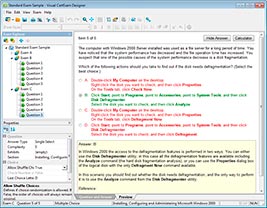
HOW TO OPEN VCE FILES
Use VCE Exam Simulator to open VCE files
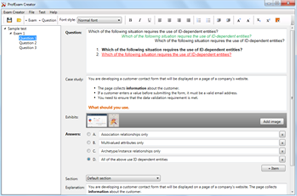
HOW TO OPEN VCEX AND EXAM FILES
Use ProfExam Simulator to open VCEX and EXAM files
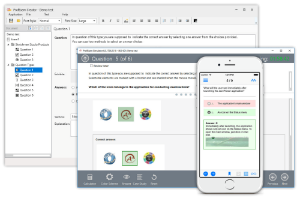
ProfExam at a 20% markdown
You have the opportunity to purchase ProfExam at a 20% reduced price
Get Now!