Download Revenue Cloud Consultant Accredited Professional.Revenue-Cloud-Consultant-Accredited-Professional.Pass4Success.2026-10-19.58q.vcex
| Vendor: | Salesforce |
| Exam Code: | Revenue-Cloud-Consultant-Accredited-Professional |
| Exam Name: | Revenue Cloud Consultant Accredited Professional |
| Date: | Oct 19, 2026 |
| File Size: | 207 KB |
How to open VCEX files?
Files with VCEX extension can be opened by ProfExam Simulator.
Discount: 20%

Demo Questions
Question 1
How does Hold Billingwork?
- It Prevents invoice document generation and stops email notificationsfrom going outto the customer.
- The Hold Billing field is set to ''yes'' until the order is activated. Upon order activationthe field will be automatically set to ''no''.
- It suspends invoicing for that order product until the field is set to ''no'', Invoices lineswill be created to account for the time when hold billing was set to ''yes''
- It suspends invoicing for that order product until the fieldis set to ''no'', Invoices lineswill be created only for invoices after hold billing was set to ''yes''.
Correct answer: C
Explanation:
Hold Billing is a feature of Salesforce Revenue Cloud that allows businesses to control when an order product is invoiced, based on certain criteria or events. By setting theHold Billing field toYes on an order product, the billing process is paused for that order product and all its usage summaries. This means that no invoice lines or invoice documents are generated for the order product until the hold is released. The holdcan be released by setting the Hold Billing field to No or null, either manually or automatically through a workflow or trigger. When the hold is released, Salesforce Billing will create an invoice as soon as possible, and include all the invoice lines that were accumulated during the hold period. This ensures that the customer is billed for the full amount of the order product, regardless of the hold duration. For example, if an order product has a monthly billing frequency and a hold billing period of twomonths, the first invoice after the hold will include three invoice lines: one for the current month and two for the previous months when the hold was active.Reference:https://help.salesforce.com/s/articleView?id=sf.blng_hold_billing.htm&language=en_US&type=5https://trailhead.salesforce.com/users/officialblaze/trailmixes/revenue-cloud-get-started-with-billing
Question 2
Universal Containers has recently implemented and released CPQ to users in their production environment. After an extensive testing Cycle in a sandboxed environment.
One of the automations implemented was to set everynew quote created as "primary" at the time of creation in order to save clicks. Users immediately began to report errors when trying to create quotes in the production environment for the first time. What could have caused this issue?
- The User did not execute post-installation scripts upon their first login to CPQ.
- The User did not have the proper access to the Opportunity Product object.
- The User did not have the proper access to the Quote Line object.
- The User did not have the proper accessto the Quote Object.
Correct answer: A
Explanation:
According to the Salesforce Revenue Cloud CPQ documentation, users need to have the Create, Read, Edit, and Delete permissions on the Quote object in order to create and manage quotes. If users do not have the proper accessto the Quote object, they will encounter errors when trying to create quotes, even if the quotes are set as primary by default. This is because the primary quote field is a lookup field that references the Quote object, and users need to have access to the referenced object in order to populate the lookup field. Therefore, the most likely cause ofthe issue is that the users did not have the proper access to the Quote object in the production environment, and this was not detected in the sandbox environment because the users had different permissions or profiles there.Reference:https://help.salesforce.com/s/articleView?id=000316738&language=en_US&type=1https://help.salesforce.com/s/articleView?id=000381216&language=no&type=1In Salesforce CPQ, ensuring that users have the proper access to the Quote object is crucialfor the smooth creation and management of quotes. The issue reported by users in the production environment, where errors occurred upon trying to create quotes for the first time, likely stemmed from insufficient permissions on the Quote object. In CPQ, setting a new quote as 'primary' at the time of creation is a common practice to streamline the quoting process. However, if users lack the necessary permissions on the Quote object, they would encounter errors when attempting to create or modify quotes. It's important to note that in Salesforce CPQ, orders must be created from a primary quote, and once an order is created from a primary quote, the quote cannot be edited. This indicates that the underlying issue is related to access permissions on the Quote object, rather than post-installation scripts, access to the Opportunity Product object, or access to the Quote Line object.
Question 3
Which topic of discussion comes first in a salesforce CPQ Scoping Session?
- Business Process Mapping
- Quote Document and e-signature
- Order Management
- Products and Bundles
Correct answer: A
Explanation:
In a Salesforce CPQ Scoping Session, the first topic of discussion is typically Business Process Mapping.This involves understanding the current business processes and identifying areas where Salesforce CPQ can provide improvements. It's an essential step in the scoping process as it helps to define the project's scope and identify potential challenges earlyon. The other topics like Quote Document and e-signature, Order Management, and Products and Bundles are also important but they usually come after the business processes have been mapped and understood.ReferenceGet Started with Salesforce CPQ Unit | Salesforce TrailheadCPQ Scoping Questionaire? : r/salesforce -RedditHow To: Salesforce CPQ: Build a Bundle
Question 4
A Subscription-based company has a Revenue Cloud user story to replace their legacy system which states "As a Sales User, I need to see my active deals (Including new and renewals opportunities) from the old system carried over to the new Salesforce CPQ system once we go-live".
What are the relevant objects that will store the extracted information from the legacy system?
- Accounts, Opportunities, Contracts, Subscriptions, Assets, Products
- Accounts, Opportunities, Quotes, Contracts, Subscriptions, Products
- Accounts, Opportunities, Quotes, Contracts, Products, Order Products
- Accounts, Opportunities, Orders, Contracts, Order Products
Correct answer: B
Question 5
What three key considerations for legacy data migration will expand the project scope of a Revenue Cloud implementation?
- Fragmented and incomplete information will need to be aggregated and validated, otherwise the solution will yield unexpected results
- Extracting from multiple sources takes additional resourcesand time to access and process
- The creation of external objects will bypass the need for legacy data migration
- The Amendments and Renewals process will be subject to customizations
- Large volumes of data take a longer time to load.
Correct answer: A, B, E
Explanation:
Legacy data migration is a critical aspect of a Revenue Cloud implementation and certain considerations can indeed expand the project scope:A . Fragmented and incomplete information will need to be aggregated and validated, otherwise the solution will yield unexpected results: Data quality is a key factor in any data migration project.If the legacy data is fragmented or incomplete, additional effort will be required to aggregate and validate the data before it can be migrated to the new system1.B . Extracting from multiple sources takes additional resources and time to access and process: If the legacy data resides in multiple sources, it can increase the complexity of the data extraction process.This can require additional resources and time, thus expanding the projectscope1.E . Large volumes of data take a longer time to load: The volume of data to be migrated can significantly impact the time required for the data load process.Large volumes of data can take a longer time to load, which can extend the project timeline2.C . The creation of external objects will bypass the need for legacy data migration: While creating external objects can help integrate external data sources with Salesforce, it doesn't necessarily bypass the need for data migration.The data still needs to be accessible and in a format that Salesforce can understand3.D .The Amendments and Renewals process will be subject to customizations: While amendments and renewals are important aspects of the CPQ process, they are not directly related to the data migration process3.
Question 6
A revenue cloud consultant determines that price rules will not address additionalcalculation steps to accurately set the quote line list price needed for a project. What isthe next functionality that should be investigated that will address the requirements?
- Use a Record Change Flow to trigger on the Quote Line.
- A Quote Calculator plugin(QCP)
- Set Pricing Method to Custom
- Use an Apex Trigger on the Quote Line
Correct answer: B
Explanation:
In Salesforce Revenue Cloud, if price rules are not sufficient to accurately set the quote line list price for a project, the next functionality to consider would be a Quote Calculator Plugin (QCP)1.A QCP is a JavaScript snippet that you can use to perform complex calculations and manipulations on quote lines1.It provides a way to customize the calculation sequence that happens when a quote is calculated1.This can be particularly useful when there are additional calculation steps needed that are not addressed by standard price rules1.ReferenceSalesforce Exam Revenue-Cloud-Consultant-Accredited-Professional Questions and Answers - Update Feb 2024
Question 7
Which three are key steps when documenting user stories?
- Know which business process the requirement supportsto categorize the user story
- Identity the actor or personas in this user story
- Design the solution while the business process is being defined
- Document user acceptance test scripts for the user story.
- Identify the acceptance criteria or resultfor satisfying the user story.
Correct answer: A, B, E
Explanation:
User stories are short, simple descriptions of a feature or functionality from the perspective of the end user or customer. User stories are used to capture the requirements and value proposition of a productor service in an agile framework. User stories should follow some best practices to ensure clarity, consistency, and alignment with the business goals and user needs.12Some of the key steps when documenting user stories are:Know which business process the requirement supports to categorize the user story. This helps to prioritize and organize theuser stories based on the business value and impact they deliver. It also helps to avoid duplication and inconsistency among user stories.3Identify theactor or personas in this user story. This helps to define the user role, needs, goals, and motivations that drive the user story. It also helps to create empathy and understanding for the user and their context.4Identify the acceptance criteria or result for satisfying the user story. This helps to specify the expected outcome, behavior, or functionality that the user story should deliver. It also helps to define the scope, quality, and testability of the user story.5Designing the solution while the business process is being defined is not a key step when documenting user stories. This canlead to premature or biased decisions that may not address the real user problem or value proposition. User stories should focus on the what and why, not the how. The solution design should be done after the user stories are validated and prioritized, andin collaboration with the development team and other stakeholders.6Documenting user acceptance test scripts for the user story is not a key step when documenting userstories. This can be done later, after the user stories are refined and detailed, and before the development and testing phases. User acceptance test scripts are used to verify that the user story meets the acceptance criteria and the user expectations. [7]1: User Stories | Examples and Template | Atlassian2: How to Write Perfect User Stories (With Templates): A Step-By-Step Guide | airfocus3: 10 Tips for Writing Good User Stories - Roman Pichler4: The Anatomy of a User Story | Scrum Alliance | Includes Template5: Best Practices to Succeed with User Stories - DZone6: UX documentation: Guide, best practices, template
Question 8
How can a Revenue Cloud Consultant create a new payment Method for a credit card thatwill be saved for future Payments?
- Enter the credit card details into a new payment Method record Click the Tokenizebutton
- From the Payment credit cards related list, click the new credit card button.
- Enter the credit card details intoa new payment method record. salesforce users should use platform encryption for PCI Compliance.
- From the Account, Payment Method related list, then click the new Payment MethodCredit Card button.
Correct answer: D
Explanation:
To create a new payment method for acredit card that will be saved for future payments, the Revenue Cloud Consultant should follow these steps:Navigate to the account record that needs the new payment method.Find the Payment Methods related list, and then click New Payment Method Credit Card. This button opens a form that allows entering the credit card details, such as card number, expiration date, cardholder name, and billing address.Optionally, select a payment gateway record to associate the payment method with a specific gateway. If no payment gateway is selected, the default gateway for the org is used.Optionally, select the Autopay checkbox to make this payment method the default one for all transactions on this account.Click Save. This action creates a new payment method record and also sends a request to the payment gateway to tokenize the credit card information. Tokenization is a process that replaces sensitive data with a unique identifier that can be used for payment processing without exposing the original data.Once the payment gateway returns a token, the payment method record is updated with the token value in the Payment Gateway Token field. This token is used to process payments with this payment method in the future.Create a Credit Card Payment MethodPayment MethodsPayments and Credits
Question 9
What are the 3 reasons why you would need an appexchangesolution to supportgenerating a document is support of a revenue cloud project?
- watermarks
- Attachments
- Electronic signature
- Contract Redlining
- Invoice Generation
Correct answer: A, C, D
Explanation:
Salesforce AppExchange offers a variety of solutions that can enhance the functionality of Salesforce Revenue Cloud. Here are the reasons why you would need an AppExchange solution to support generating a document in support of a Revenue Cloud project:Watermarks (A): Watermarks can be used to mark documents asconfidential or to denote the status of the document (draft, approved, etc.). AppExchange solutions can provide this functionality, which is not available out-of-the-box in Salesforce.Electronic Signature : Electronic signatures are often required for contracts and other legal documents. AppExchange solutions like DocuSign can integrate with Salesforce to provide this functionality.Contract Redlining (D): Contract redlining allows for tracking changes and comments during the contract negotiation process.This is a specialized functionality that can be provided by AppExchange solutions.Reference10 Benefits of Using Salesforce AppExchange Apps - Cloud AnalogyRevenue Cloud Collection Page - SalesforceExtending Customer 360 with Salesforce AppExchangeWhat Is Salesforce AppExchange and How Can I Use It?
Question 10
What is the most Scalable way to set the legal Entityon the Order Product and OrderProduct Consumption Schedule?
- Use a WorkFlow
- Use a Custom Setting
- Use a Quote Calculator Plugin(QCP)
- Use a Flow that is triggered when the record is created and run before the record is saved.
Correct answer: D
Explanation:
A Flow is a scalable way to set the legal entity on the order product and order product consumption schedulebecause it allows you to automate complex business logic without writing code. A Flow can be triggered when a record is created and run before the record is saved, which means that you can assign the legal entity to the order product and order product consumption schedule before they are inserted into the database. This way, you can ensure that the order product and order product consumption schedule have the correct legal entity for the billing, tax, and revenue recognition treatments that are applied to them. A Flow also gives you more flexibility and control over the logic and criteria for setting the legal entity, compared to a workflow or a custom setting. A Quote Calculator Plugin (QCP) is not a scalable way to set the legal entity on the order productand order product consumption schedule because it is a custom code solution that requires development and maintenance. A QCP also runs after the order product and order product consumption schedule are created, which means that you have to update the legal entity after the record is saved, which can cause data validation issues. A workflow or a custom setting are also not scalable ways to set the legal entity on the order product and order product consumption schedule because they have limitations and drawbacks, such as:A workflow can only run after the record is created and saved, which means that you have to update the legal entity after the record is saved, which can cause data validation issues.A workflow can only execute simple logic and actions, such as field updates, email alerts, tasks, and outbound messages. It cannot perform complex logic or actions, such as loops, conditions, variables, or invocations of other processes or services.A custom setting is a type of custom metadata that stores datathat can be accessed by formulas, validation rules, flows, Apex, and the SOAP API. However, a custom setting is not a good way to store data that changes frequently or varies by user or profile, such as the legal entity. A custom setting also requires manual configuration and maintenance, which can be error-prone and time-consuming.Reference:Legal EntitiesAutomation Guidelines for Orders and Order ProductsFlow Builder
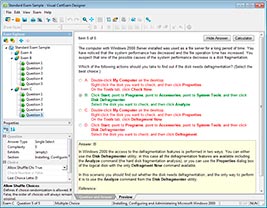
HOW TO OPEN VCE FILES
Use VCE Exam Simulator to open VCE files
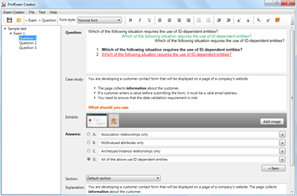
HOW TO OPEN VCEX AND EXAM FILES
Use ProfExam Simulator to open VCEX and EXAM files
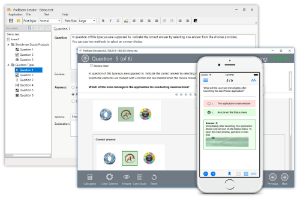
ProfExam at a 20% markdown
You have the opportunity to purchase ProfExam at a 20% reduced price
Get Now!