Download Designing and Implementing Cloud-Native Applications Using Microsoft Azure Cosmos DB.DP-420.ExamTopics.2025-08-18.89q.vcex
| Vendor: | Microsoft |
| Exam Code: | DP-420 |
| Exam Name: | Designing and Implementing Cloud-Native Applications Using Microsoft Azure Cosmos DB |
| Date: | Aug 18, 2025 |
| File Size: | 5 MB |
| Downloads: | 4 |
How to open VCEX files?
Files with VCEX extension can be opened by ProfExam Simulator.
Discount: 20%

Demo Questions
Question 1
Note: This question is part of a series of questions that present the same scenario. Each question in the series contains a unique solution that might meet the stated goals. Some question sets might have more than one correct solution, while others might not have a correct solution.
After you answer a question in this section, you will NOT be able to return to it. As a result, these questions will not appear in the review screen.
You have an Azure Cosmos DB Core (SQL) API account named account1 that uses autoscale throughput.
You need to run an Azure function when the normalized request units per second for a container in account1 exceeds a specific value.
Solution: You configure Azure Event Grid to send events to the function by using an Event Grid trigger in the function.
Does this meet the goal?
- Yes
- No
Correct answer: B
Explanation:
Instead configure an Azure Monitor alert to trigger the function.You can set up alerts from the Azure Cosmos DB pane or the Azure Monitor service in the Azure portal.Reference:https://docs.microsoft.com/en-us/azure/cosmos-db/create-alerts Instead configure an Azure Monitor alert to trigger the function.
You can set up alerts from the Azure Cosmos DB pane or the Azure Monitor service in the Azure portal.
Reference:
https://docs.microsoft.com/en-us/azure/cosmos-db/create-alerts
Question 2
You have three containers in an Azure Cosmos DB Core (SQL) API account as shown in the following table.

You have the following Azure functions:
- A function named Fn1 that reads the change feed of cn1
- A function named Fn2 that reads the change feed of cn2
- A function named Fn3 that reads the change feed of cn3
You perform the following actions:
- Delete an item named item1 from cn1.
- Update an item named item2 in cn2.
- For an item named item3 in cn3, update the item time to live to 3,600 seconds.
For each of the following statements, select Yes if the statement is true. Otherwise, select No.
NOTE: Each correct selection is worth one point.
Correct answer: To work with this question, an Exam Simulator is required.
Explanation:
Box 1: No -Azure Cosmos DB's change feed is a great choice as a central data store in event sourcing architectures where all data ingestion is modeled as writes (no updates or deletes).Note: The change feed does not capture deletes. If you delete an item from your container, it is also removed from the change feed. The most common method of handling this is adding a soft marker on the items that are being deleted. You can add a property called "deleted" and set it to "true" at the time of deletion. This document update will show up in the change feed. You can set a TTL on this item so that it can be automatically deleted later.Box 2: No -The _etag format is internal and you should not take dependency on it, because it can change anytime.Box 3: Yes -Change feed support in Azure Cosmos DB works by listening to an Azure Cosmos container for any changes.Reference:https://docs.microsoft.com/en-us/azure/cosmos-db/sql/change-feed-design-patterns https://docs.microsoft.com/en-us/azure/cosmos-db/change-feed Box 1: No -
Azure Cosmos DB's change feed is a great choice as a central data store in event sourcing architectures where all data ingestion is modeled as writes (no updates or deletes).
Note: The change feed does not capture deletes. If you delete an item from your container, it is also removed from the change feed. The most common method of handling this is adding a soft marker on the items that are being deleted. You can add a property called "deleted" and set it to "true" at the time of deletion. This document update will show up in the change feed. You can set a TTL on this item so that it can be automatically deleted later.
Box 2: No -
The _etag format is internal and you should not take dependency on it, because it can change anytime.
Box 3: Yes -
Change feed support in Azure Cosmos DB works by listening to an Azure Cosmos container for any changes.
Reference:
https://docs.microsoft.com/en-us/azure/cosmos-db/sql/change-feed-design-patterns https://docs.microsoft.com/en-us/azure/cosmos-db/change-feed
Question 3
You have a global ecommerce application that stores data in an Azure Cosmos DB Core (SQL) API account. The account is configured for multi-region writes.
You need to create a stored procedure for a custom conflict resolution policy for a new container. In the event of a conflict caused by a deletion, the deletion must always take priority.
Which parameter should you check in the stored procedure function?
- isTombstone
- conflictingItems
- existingItem
- incomingItem
Correct answer: A
Explanation:
A: 3 - Mosted A: 3 - Mosted
Question 4
You are building an application that will store data in an Azure Cosmos DB Core (SQL) API account. The account uses the session default consistency level. The account is used by five other applications. The account has a single read-write region and 10 additional read region.
Approximately 20 percent of the items stored in the account are updated hourly.
Several users will access the new application from multiple devices.
You need to ensure that the users see the same item values consistently when they browse from the different devices. The solution must NOT affect the other applications.
Which two actions should you perform? Each correct answer presents part of the solution.
NOTE: Each correct selection is worth one point.
- Set the default consistency level to eventual
- Associate a session token to the device
- Use implicit session management when performing read requests
- Provide a stored session token when performing read requests
- Associate a session token to the user account
Correct answer: DE
Explanation:
BC: 7BD: 1DE: 13 - Mosted BC: 7BD: 1DE: 13 - Mosted
Question 5
You plan to store order data in an Azure Cosmos DB Core (SQL) API account. The data contains information about orders and their associated items.
You need to develop a model that supports order read operations. The solution must minimize the number of requests.
What should you do?
- Create a database for orders and a database for order items.
- Create a single database that contains a container for orders and a container for order items.
- Create a single database that contains one container. Store orders and order items in separate documents in the container.
- Create a single database that contains one container. Create a separate document for each order and embed the order items into the order documents.
Correct answer: D
Explanation:
B: 1D: 11 - Mosted B: 1D: 11 - Mosted
Question 6
You have a database named db1 in an Azure Cosmos DB Core (SQL) API account.
You are designing an application that will use db1.
In db1, you are creating a new container named coll1 that will store online orders.
The following is a sample of a document that will be stored in coll1.
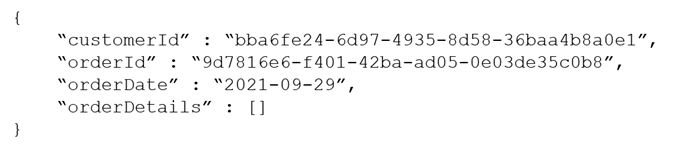
The application will have the following characteristics:
- New orders will be created frequently by different customers.
- Customers will often view their past order history.
You need to select the partition key value for coll1 to support the application. The solution must minimize costs.
To what should you set the partition key?
- orderId
- customerId
- orderDate
- id
Correct answer: B
Explanation:
B: 3 - Mosted B: 3 - Mosted
Question 7
You have a container in an Azure Cosmos DB Core (SQL) API account. The container stores telemetry data from IoT devices. The container uses telemetryId as the partition key and has a throughput of 1,000 request units per second (RU/s). Approximately 5,000 IoT devices submit data every five minutes by using the same telemetryId value.
You have an application that performs analytics on the data and frequently reads telemetry data for a single IoT device to perform trend analysis.
The following is a sample of a document in the container.
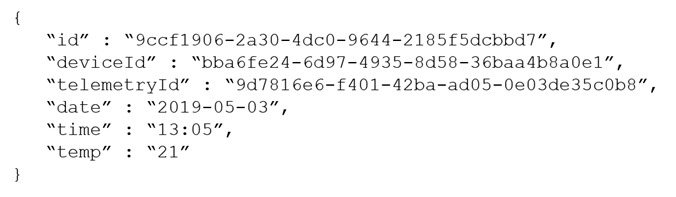
You need to reduce the amount of request units (RUs) consumed by the analytics application.
What should you do?
- Decrease the offerThroughput value for the container.
- Increase the offerThroughput value for the container.
- Move the data to a new container that uses a partition key of deviceId.
- Move the data to a new container that uses a partition key of temp.
Correct answer: C
Explanation:
C: 5 - Mosted C: 5 - Mosted
Question 8
You have a database named db1 in an Azure Cosmos DB Core (SQL) API account.
You have a third-party application that is exposed through a REST API.
You need to migrate data from the application to a container in db1 on a weekly basis.
What should you use?
- Azure Migrate
- Azure Data Factory
- Database Migration Assistant
Correct answer: B
Explanation:
B: 9 - Mosted B: 9 - Mosted
Question 9
You have a database in an Azure Cosmos DB Core (SQL API) account. The database contains a container named container1. The indexing mode of container1 is set to none.
You configure Azure Cognitive Search to extract data from container1 and make the data searchable.
You discover that the Cognitive Search index is missing all the data from the Azure Cosmos DB index.
What should you do to resolve the issue?
- Modify the index attributes in Cognitive Search to Searchable
- Modify the index attributes in Cognitive Search to Retrievable
- Modify the indexing policy of container1 to exclude the /* path
- Change the indexing mode of container1 to consistent
Correct answer: D
Explanation:
D: 5 - Mosted D: 5 - Mosted
Question 10
You have a container named container1 in an Azure Cosmos DB Core (SQL) API account named account1 that is set to the session default consistency level. The average size of an item in contained is 20 KB.
You have an application named App1 that uses the Azure Cosmos DB SDK and performs a point read on the same set of items in container1 every minute.
You need to minimize the consumption of the request units (RUs) associated to the reads by App1.
What should you do?
- In App1, modify the connection policy settings
- In App1, change the consistency level of read requests to consistent prefix
- In account1, provision a dedicated gateway and integrated cache
- In account1, change the default consistency level to bounded staleness
Correct answer: C
Explanation:
B: 1C: 4 - Mosted B: 1C: 4 - Mosted
Question 11
You have an Azure Cosmos DB Core (SQL) API account named account1 that has a single read-write region and one additional read region. Account1 uses the strong default consistency level.
You have an application that uses the eventual consistency level when submitting requests to account1.
How will writes from the application be handled?
- Writes will use the eventual consistency level.
- Azure Cosmos DB will reject writes from the application.
- Writes will use the strong consistency level.
- The write order is not guaranteed during replication.
Correct answer: C
Explanation:
C: 2 - MostedOverriding the default consistency level only applies to reads within the SDK client. An account configured for strong consistency by default will still write and replicate data synchronously to every region in the account. When the SDK client instance or request overrides this with Session or weaker consistency, reads will be performed using a single replica.Reference:https://docs.microsoft.com/en-us/azure/cosmos-db/consistency-levels C: 2 - Mosted
Overriding the default consistency level only applies to reads within the SDK client. An account configured for strong consistency by default will still write and replicate data synchronously to every region in the account. When the SDK client instance or request overrides this with Session or weaker consistency, reads will be performed using a single replica.
Reference:
https://docs.microsoft.com/en-us/azure/cosmos-db/consistency-levels
HOW TO OPEN VCE FILES
Use VCE Exam Simulator to open VCE files
HOW TO OPEN VCEX AND EXAM FILES
Use ProfExam Simulator to open VCEX and EXAM files
ProfExam at a 20% markdown
You have the opportunity to purchase ProfExam at a 20% reduced price
Get Now!