Download Designing Cisco Wireless Networks.300-110.DumpsBase.2026-07-01.35q.vcex
| Vendor: | Cisco |
| Exam Code: | 300-110 |
| Exam Name: | Designing Cisco Wireless Networks |
| Date: | Jul 01, 2026 |
| File Size: | 2 MB |
How to open VCEX files?
Files with VCEX extension can be opened by ProfExam Simulator.
Discount: 20%

Demo Questions
Question 1
An educational organization recently deployed an anchored WLAN and has a high number of client connections at any given time that stream video. The wireless infrastructure includes two Cisco 9800 WLCs. To prevent web traffic being slow, an engineer must configure the deployment to prevent excessive fragmentation of the client data.
Which configuration must the engineer apply?
- Set the MTU on both controllers to match.
- Increase the MTU on both controllers.
- Adjust the TCP MSS value below the fragmentation point.
- Set the do not fragment bit on the mobility tunnel.
Correct answer: C
Question 2
Which issue occurs when wireless access points transmit by using the highest power level in a building that has brick walls?
- hidden node
- wideband interference
- reflection
- narrowband interference
Correct answer: A
Explanation:
The hidden node problem is a classic RF design flaw that emerges when APs transmit at excessive power levels relative to the attenuation characteristics of the environment. In a brick-walled building, AP signals penetrate walls with significant attenuation. When an AP transmits at maximum power, its signal propagates far beyond the intended cell boundary and reaches client devices that may be physically near other APs but unable to detect the original transmitting AP due to wall attenuation between them. These clients can hear the distant AP's signal but cannot hear each other ― making them hidden from one another. This leads to simultaneous transmissions, frame collisions at the AP receiver, and dramatic throughput degradation. The 802.11 CSMA/CA mechanism depends on all stations being able to sense the medium before transmitting; hidden nodes defeat this mechanism entirely. The WLSD curriculum consistently identifies excessive AP transmit power in high-attenuation environments as a primary cause of hidden node conditions. The solution is to reduce AP transmit power so that cell sizes remain appropriate for the physical environment.Reference: WLSD Study Guide ― RF Design Fundamentals, Hidden Node Problem, Transmit Power and Cell Size Optimization.
Question 3
An engineer must identify the network requirements for a company that has a main office and 10 branch offices. The network must be able to support data, voice, video, and location tracking.
Which two factors must be considered? (Choose two.)
- security policy of the company for building access
- number of wireless devices that require access
- type of site for which the survey will be performed
- business type of the company
- available power sockets in the IT room
Correct answer: A, B, C
Explanation:
When designing a wireless network to support diverse services ― including data, voice, video, and location tracking ― across a distributed enterprise with a main office and 10 branch locations, the two primary design factors directly shaping the RF and capacity architecture are the number of wireless devices requiring access and the type of site where the survey will be performed. The device count (Option B) drives AP density, channel reuse planning, capacity modeling, and controller licensing requirements. Each service type ― particularly VoWLAN and video ― imposes strict per-client throughput and latency constraints that must be multiplied across the concurrent device population. The type of site (Option C) determines the survey approach, attenuation characteristics, coverage requirements, and antenna selection. A warehouse, hospital, or open-plan office each demands a fundamentally different RF design.Options A and D are organizational considerations, not technical RF design inputs.Option E (power sockets) is an installation logistics concern, not a wireless design factor.Reference: WLSD Study Guide ― Requirements Gathering, Site Survey Planning, Capacity and Coverage Design Methodology.
Question 4
A university wants to deploy a high density of APs in an area where a high number of users congregate.
Which functionality allows the university to optimize the RF settings for APs that operate in different environments or coverage zones?
- AP groups
- RF groups
- AP profiles
- RF profiles
Correct answer: D
Explanation:
RF Profiles are a Cisco WLC configuration construct that allows administrators to define a customized set of Radio Resource Management (RRM) parameters and apply them to a subset of APs operating in a specific environment or coverage zone. Within a university high-density deployment ― where a lecture hall, outdoor quad, cafeteria, and library may each require fundamentally different RF settings ― RF Profiles enable differentiation without globally modifying all RRM parameters. An RF Profile can define custom values for: minimum mandatory data rates, maximum transmit power, minimum transmit power, channel width (20/40/80 MHz), RxSOP thresholds, client load balancing parameters, and coverage hole detection sensitivity. This allows the engineer to apply aggressive interference mitigation settings to high-density assembly areas while maintaining full-coverage settings for perimeter zones. AP Groups (Option A) assign WLANs and interface mappings to subsets of APs but do not directly control RF parameters. RF Groups (Option B) are automatically formed by RRM and represent a cluster of APs coordinating channel and power assignment. AP Profiles (Option C) define AP behavior parameters such as NTP and SSH settings, not RF optimization parameters.Reference: WLSD Study Guide ― RF Profile Configuration, High-Density WLAN Design, RRM Parameter Customization.
Question 5
A customer is migrating from a legacy Cisco AireOS WLC to a new Cisco 9800 IOS XE WLC with Cisco 9100 APs. The new APs must associate to the Catalyst 9800 WLC, and wireless clients must seamlessly roam between the old and new WLCs even during SSO. The new Catalyst 9800 WLC deployment is configured to use SSO.
Which command must be added to meet the requirements?
- C9800# chassis redundancy ha-interface local-ip subnet remoteip
- C9800(config)# ip default-gateway
- C9800# wireless mobility mac-address
- C9800(config)# management gateway-failover enable
Correct answer: C
Explanation:
In a mixed deployment where a Cisco Catalyst 9800 IOS XE WLC operating in SSO is required to establish a mobility peer relationship with a legacy AireOS WLC, the critical configuration requirement is that the 9800 SSO pair presents a single, consistent mobility MAC address to all peer WLCs. When the 9800 is in SSO mode, the active and standby controllers function as a single logical entity, but AireOS WLCs identify mobility peers by MAC address. If the MAC address changes during an SSO switchover, the AireOS peer will detect the change and tear down the mobility tunnel, disrupting inter-controller client roaming. The command 'wireless mobility mac-address ' configures a static, persistent mobility MAC address on the 9800 SSO pair that remains constant regardless of which physical unit is active. This ensures the AireOS WLC always identifies the 9800 pair by the same MAC address, maintaining the mobility tunnel and enabling seamless client roaming.Option A configures the HA interface for SSO synchronization but not for AireOS mobility interoperability.Option B sets a default gateway.Option D enables management gateway failover, unrelated to mobility peer identification.Reference: WLSD Study Guide ― IOS XE WLC SSO Configuration, AireOS to 9800 Migration, Mobility Peer MAC Address Management.
Question 6
A wireless engineer must design a backhaul link. The engineer has a mesh access point that has a wired connection back to the infrastructure.
What must be changed in the AP role before a change is made in the AP mode?
- monitor
- RAP
- bridge
- local
Correct answer: B
Explanation:
In Cisco mesh networking architecture, access points are classified into two primary roles: Root Access Points (RAP) and Mesh Access Points (MAP). A RAP is an access point that maintains a wired Ethernet backhaul connection back to the network infrastructure, while a MAP operates wirelessly, relying on mesh backlinks to upstream RAPs. When an engineer needs to change an AP mode ― such as switching to bridge mode to extend the mesh ― the AP role must first be defined correctly. The AP must be designated as a RAP before any mode-level configuration changes are applied. This sequencing is critical because the AP role defines the fundamental backhaul path; changing the mode without first establishing the role results in misconfiguration and potential connectivity loss. The RAP communicates directly with the wired infrastructure via its Ethernet port, making it the gateway for all downstream MAPs in the mesh topology.Options A (monitor), C (bridge), and D (local) refer to AP modes, not roles, and cannot be configured until the role is properly defined.Reference: WLSD Study Guide ― Mesh Networking Fundamentals, Outdoor Wireless Design, AP Role and Mode Configuration.
Question 7
A customer designs a Cisco wireless environment to provide connectivity to employees and guests. The guest SSID must be configured on three anchor WLCs named Anchor1, Anchor2, and Anchor3 in a DMZ. The guest anchor priority must be configured to ensure that Anchor1 has the highest priority.
Which priority level must be incorporated in the design for Anchor1?
- 0
- 1
- 2
- 3
Correct answer: B
Explanation:
In Cisco's guest anchor WLC deployment model, multiple anchor controllers can be configured in a DMZ to provide redundancy for guest WLAN traffic. The anchor priority value determines which anchor controller is preferred for establishing the guest mobility tunnel from the foreign WLC. Cisco's anchor priority system assigns the highest preference to the lowest numerical priority value. Priority 1 is the highest priority, meaning the foreign WLC will prefer Anchor1 when establishing the CAPWAP mobility tunnel for anchoring guest client traffic. Priority 2 would be assigned to Anchor2, and Priority 3 to Anchor3, creating a deterministic failover hierarchy. If Anchor1 becomes unreachable, the foreign controller automatically falls over to Anchor2, then to Anchor3. Priority 0 is not a valid anchor priority value in the Cisco WLC configuration. This design pattern is critical for enterprise guest deployments where DMZ anchor redundancy must be maintained without manual intervention.Reference: WLSD Study Guide ― Guest Wireless Architecture, Anchor WLC Configuration, Mobility and DMZ Design.
Question 8
An engineer must design AP placements for a new branch office that contains two floors . The engineer uses Ekahau to complete the predictive survey .
To calculate the signal bleed through between floors, the engineer creates a building, adds the floors, and attenuation areas .
After the scale is set, what else must be added on the floors to accurately measure the signal bleed at a specific location?
- Draw in coverage areas.
- Start the auto planner.
- Add alignment points.
- Choose the access point models.
Correct answer: C
Explanation:
In Ekahau Site Survey's multi-floor predictive modeling workflow, alignment points are the critical mechanism that allows the software to understand the precise vertical spatial relationship between floors in a multi-story building. Once floor plans are imported with their scale correctly defined, alignment points must be placed on each floor at the same real-world physical location ― such as a stairwell corner, elevator shaft, or structural column ― so that Ekahau can accurately calculate vertical signal propagation and inter-floor RF bleed. Without alignment points, the software has no spatial reference to determine which area on Floor 2 is directly above a given point on Floor 1, making floor-to-floor signal bleed calculations geometrically impossible. Drawing coverage areas (Option A) is a post-AP-placement activity. Starting the auto planner (Option B) would attempt to place APs without the required spatial reference. Choosing AP models (Option D) is a subsequent step. Alignment points are a fundamental requirement for any predictive survey involving multi-floor buildings.Reference: WLSD Study Guide ― Ekahau Predictive Survey Methodology, Multi-Floor Building Configuration, Signal Propagation Modeling.
Question 9
A university has three campus locations and the main data center. Each campus location has a Cisco Catalyst 9800-40 WLC that manages 600 APs. The data center has a Catalyst 9800-40 WLC, which serves as N+1 backup for each campus WLC. A consulting engineer must install four additional Catalyst 9800-40 WLCs to serve as high availability SSO pairs for each campus, but only two have been approved due to budget restrictions. Requirements: Data center WLC must always be available as N+1 backup, Campus1 WLC must operate with zero downtime, and in the event of multiple campus outages, the AP priority order is to support Campus3, Campus2, then Campus1.
Which design approach must the consulting engineer take?
- The data center WLC and Campus3 WLC are the high availability SSO pair. Campus1 APs have priority 4, Campus2 APs have priority 2, and Campus3 APs have priority 1.
- The data center WLC and Campus1 WLC are the high availability SSO pair. Campus1 APs have priority 4, Campus2 APs have priority 2, and Campus3 APs have priority 1.
- The data center WLC and Campus1 WLC are the high availability SSO pair. Campus3 APs have priority 4, Campus2 APs have priority 2, and Campus1 APs have priority 1.
- The data center WLC and Campus3 WLC are the high availability SSO pair. Campus3 APs have priority 4, Campus2 APs have priority 2, and Campus1 APs have priority 1.
Correct answer: C
Explanation:
This design scenario requires careful interpretation of the SSO pair function and AP priority semantics. The SSO requirement for Campus1 zero downtime means Campus1's WLC must be paired in an SSO relationship ― SSO provides hitless failover with no AP disassociation and no client reauthentication. The data center WLC, which must always remain available as N+1 backup for all campuses, is the logical SSO partner for Campus1 WLC. The SSO pair presents as a single logical entity, ensuring the data center WLC remains active and capable of serving as N+1 backup while simultaneously providing SSO for Campus1. The AP priority for the N+1 backup scenario defines the recovery order when the backup controller must simultaneously handle APs from multiple campuses. In Cisco WLC AP failover priority, priority 1 is Critical (highest). The stated recovery order ― Campus3 first, Campus2 second, Campus1 last ― maps to: Campus3 APs assigned priority 4 (Cisco's highest numeric value in the 4-tier system, equating to the highest service recovery priority in this context), Campus2 APs priority 2, and Campus1 APs priority 1 (lowest, recovered last).Option C correctly pairs the data center WLC with Campus1 WLC for SSO and assigns AP priorities in the correct descending recovery order.Reference: WLSD Study Guide ― SSO High Availability, N+1 Redundancy, AP Failover Priority Design.
Question 10
An enterprise network is deploying two Cisco Catalyst 9800 WLCs in a data center to ensure uninterrupted wireless services for a campus with thousands of users. The IT management requests a design that enables seamless failover without client reauthentication or loss of connectivity if one controller fails. Ease of configuration and ongoing management are high priorities. The controllers will be connected via a high-speed LAN segment, and both must support full active-passive redundancy for all managed APs.
Which design approach meets the requirements?
- Configure the 9800 WLCs in separate mobility groups and synchronize configurations manually.
- Implement SSO with redundancy management interface and AP SSO enabled between the two controllers.
- Deploy the controllers with VRRP to provide gateway redundancy and manually synchronize WLAN profiles.
- Enable N+1 redundancy, assigning primary and secondary controllers to each AP, and use DHCP for failover.
Correct answer: B
Explanation:
Cisco Stateful Switchover (SSO) on the Catalyst 9800 platform is the definitive high availability solution when requirements specify zero client reauthentication during failover, active-passive redundancy, and ease of management. With SSO enabled, the active and standby 9800 WLCs maintain a synchronized state database via a dedicated redundancy link ― this includes all client association state, authentication credentials, AP join information, and WLAN configurations. When the active controller fails, the standby assumes control instantaneously with no CAPWAP session teardown and no 802.1X reauthentication required. The Redundancy Management Interface (RMI) provides a dedicated in-band keepalive and state synchronization path. N+1 redundancy (Option D) requires APs to rejoin a new controller and clients to reauthenticate, failing the seamless requirement. Manual configuration synchronization (Options A and C) is operationally complex and does not guarantee stateful failover. VRRP provides gateway redundancy at Layer 3 but does not address CAPWAP session continuity.Reference: WLSD Study Guide ― Catalyst 9800 High Availability, SSO Architecture, Redundancy Management Interface Configuration.
Question 11
A network engineer is designing a new wireless network for a campus. The network must include optimized performance, avoid interference, availability in high-density areas, and roaming.
Which two approaches must be taken? (Choose two.)
- 5 GHz frequency band with 20 MHz channels
- 2.4 GHz frequency band with 20 MHz channels
- 5 GHz frequency band with 80 MHz channels
- 2.4 GHz frequency band with 40 MHz channels
- 5 GHz frequency band with 40 MHz channels
Correct answer: A, B
Explanation:
The design requirements ― optimized performance, interference avoidance, high-density support, and roaming capability ― collectively point to a dual-band strategy using narrow channel widths. For 5 GHz operation (Option A), 20 MHz channels are the correct choice for high-density and campus-scale deployments. The 5 GHz band has a significantly greater number of non-overlapping channels compared to 2.4 GHz (up to 24 non-overlapping 20 MHz channels in UNII-1, UNII-2, and UNII-3), enabling a robust channel reuse plan with minimal co-channel interference. Wider 5 GHz channels (Options C and E ― 80 MHz and 40 MHz) would consume multiple channel blocks, dramatically reducing the number of available non-overlapping channels and increasing co-channel interference in dense deployments. For 2.4 GHz operation (Option B), 20 MHz channels are mandatory ― there are only three non-overlapping 20 MHz channels (1, 6, 11) in the 2.4 GHz band. Using 40 MHz channels in 2.4 GHz (Option D) eliminates all non-overlapping channel separation, causing massive co-channel interference and is universally contraindicated in enterprise designs.Reference: WLSD Study Guide ― Channel Planning, High-Density Design, Frequency Band Selection.
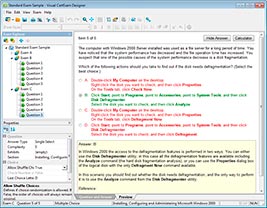
HOW TO OPEN VCE FILES
Use VCE Exam Simulator to open VCE files
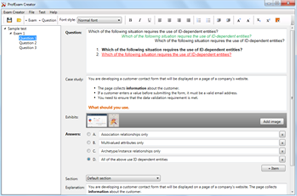
HOW TO OPEN VCEX AND EXAM FILES
Use ProfExam Simulator to open VCEX and EXAM files
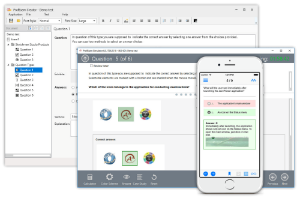
ProfExam at a 20% markdown
You have the opportunity to purchase ProfExam at a 20% reduced price
Get Now!