Download Managing Supply Chain Risk.L5M2.Pass4Success.2026-01-25.58q.vcex
| Vendor: | CIPS |
| Exam Code: | L5M2 |
| Exam Name: | Managing Supply Chain Risk |
| Date: | Jan 25, 2026 |
| File Size: | 107 KB |
How to open VCEX files?
Files with VCEX extension can be opened by ProfExam Simulator.
Discount: 20%

Demo Questions
Question 1
Which of the following are key areas of ISO 26000 Social Responsibility? Select THREE.
- organisational governance
- quality management
- human rights
- consumer issues
- efficient systems
Correct answer: A, C, D
Explanation:
1 3 and 4 are the correct answers. There are 7 key areas that ISO 26000 focuses on. As well as these three, there is also labour practices, the environment, fair operating practices and community involvement. See p. 51 of the study guide. ISOs are a popular exam topic so do revise these before the exam. 1 3 and 4 are the correct answers. There are 7 key areas that ISO 26000 focuses on. As well as these three, there is also labour practices, the environment, fair operating practices and community involvement. See p. 51 of the study guide. ISOs are a popular exam topic so do revise these before the exam.
Question 2
Juan is a Spanish business owner who imports several parts from Japan. Juan's business operates in Euros and the parts that he buys from Japan can often take a long time to arrive, this means that the price of the items sometimes fluctuates due to the exchange rate. Which of the following would be the best option for Juan?
- have the supplier quote in their own currency
- have the supplier quote in Juan's currency
- have the supplier match geographical profiles of customer sales with supplier purchases
- terminate the contract with the foreign supplier
Correct answer: B
Explanation:
quoting in Juan's currency would reduce the risk to Juan - the risk of currency exchange rate fluctuations would then sit with the supplier. See p.23 for more information on currency risks. quoting in Juan's currency would reduce the risk to Juan - the risk of currency exchange rate fluctuations would then sit with the supplier. See p.23 for more information on currency risks.
Question 3
Dave is a procurement manager for a chocolate factory who is running a tender to source cocoa from a new supplier. The tender is a huge opportunity for suppliers and the contract would be worth millions of pounds. Dave has passed some information about the tender to one of the bidders in exchange for a free holiday to Barbados. Which of the following types of fraud has Dave committed?
- holiday fraud
- accepting a kick-back
- counterfeiting
- bribery
Correct answer: D
Explanation:
This is an example of bribery. The trip to Barbados is the bribe. For more information on these types of fraud see p.19 This is an example of bribery. The trip to Barbados is the bribe. For more information on these types of fraud see p.19
Question 4
Which of the following statements is true about ISO9001? Select TWO.
- it is based on the principle of continuous improvement
- it encourages businesses to see quality from the viewpoint of the customer
- it aims to ensure sustainability within the supply chain
- It complements ISO 20400
- it helps businesses to identify areas of potential risk and mitigate these accordingly
Correct answer: A, B
Explanation:
ISO 9001 is Quality Management- answers 1 and 2 are correct. ISOs are a popular topic on this exam so be sure to revise them - and not only what the names of them are, but also the principles behind each ISO. ISO 9001 is discussed on p. 25 of the CIPS study guide. ISO 9001 is Quality Management- answers 1 and 2 are correct. ISOs are a popular topic on this exam so be sure to revise them - and not only what the names of them are, but also the principles behind each ISO. ISO 9001 is discussed on p. 25 of the CIPS study guide.
Question 5
Yusef is a new procurement manager at FRD Incorporated. He is looking through the Risk Assessments for his department and notices that the cause of the risk is not identified. Why might this be?
- this is a mistake - all risk assessments should specify the cause of the risk. He should raise this with his manager
- the organisation has a high risk appetite
- the organisation has not recorded cause for cultural reasons
- the organisation has completed the risk assessments incorrectly
Correct answer: C
Explanation:
This could be for cultural reasons within the company. P. 135 states that sometimes causes of risk are not recorded as this could lead to a blame culture within the company. This could be for cultural reasons within the company. P. 135 states that sometimes causes of risk are not recorded as this could lead to a blame culture within the company.
Question 6
A financial instrument used by airlines to fix the price of fuel over a period of time is known commonly as a what?
- commodity
- swap
- exchange
- hedge
Correct answer: B
Explanation:
This is a 'swap' and is explained on p.94. This is a type of 'hedging' but there is no such thing as 'a hedge'. For a more in-depth look at Swaps see: https://www.mercatusenergy.com/blog/bid/77634/an-introduction-to-airline-fuel-hedging-strategies-swaps This is a 'swap' and is explained on p.94. This is a type of 'hedging' but there is no such thing as 'a hedge'. For a more in-depth look at Swaps see: https://www.mercatusenergy.com/blog/bid/77634/an-introduction-to-airline-fuel-hedging-strategies-swaps
Question 7
Company X is a large manufacturer of cosmetics and household products. It operates in 57 different countries and has large and complex supply chains. The brand's popularity is partly due to the cheap price of the products compared with its competitors and Company X has recently discovered that child labour has been used within its supply chain. In response to this Company X has donated a large amount of money to charity. What is this an example of?
- corporate social responsibility
- greenwashing
- triple bottom line thinking
- business continuity planning
Correct answer: B
Explanation:
This is Greenwashing. Greenwashing is the process of using a good deed to cover up unethical responsibility. See p. 45. In this example Company X has thrown some money at a charity in order to cover up the fact it has child labour issues within the supply chain. See https://en.wikipedia.org/wiki/Greenwashing This is Greenwashing. Greenwashing is the process of using a good deed to cover up unethical responsibility. See p. 45. In this example Company X has thrown some money at a charity in order to cover up the fact it has child labour issues within the supply chain. See https://en.wikipedia.org/wiki/Greenwashing
Question 8
Which of the following is a component of the Sarbanes-Oxley Regulations?
- separation of duties
- ethical business practices
- elimination of bribery
- environmental protection
Correct answer: A
Explanation:
Separation of duties is a key component of the Sarbanes-Oxley Regulations. It ensures businesses are accounting responsibly, and one way to do this is through separation of duties (no one person has complete control of the accounts of a company). See https://www.investopedia.com/terms/s/sarbanesoxleyact.asp and p.42 in the study guide. This piece of legislation does tend to come up in the exam so do revise this topic. Separation of duties is a key component of the Sarbanes-Oxley Regulations. It ensures businesses are accounting responsibly, and one way to do this is through separation of duties (no one person has complete control of the accounts of a company). See https://www.investopedia.com/terms/s/sarbanesoxleyact.asp and p.42 in the study guide. This piece of legislation does tend to come up in the exam so do revise this topic.
Question 9
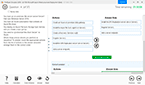
Which of the following will you put into box 6?
- strategic
- intellectual property
- environment
- operational
Correct answer: D
Explanation:
The correct answers are as follows: The correct answers are as follows:

Question 10
The USA Foreign Corrupt Practices Act (FCPA) is further reaching than the UK's Bribery Act 2010. Is this statement true?
- yes- the FCPA covers 'private bribes' and the Bribery Act does not
- yes- the FCPA exempts facilitation payments
- No- the Bribery Act extends to third parties and the FCPA does not
- No- the Bribery Act doesn't account for facilitation payments
Correct answer: C
Explanation:
The correct answer is 3. Firstly you can half the number of responses by looking at the yes / no. The UK Bribery Act is further reaching than the FCPA. Therefore the statement is False. You can therefore discount the options that start with yes. Of the two remaining statements only one of them is true and that is number 3- the Bribery Act extends to third parties and the FCPA does not. Option 4 is incorrect as the Bribery Act DOES account for facilitation payments. Its to FCPA that doesn't. This is explained on p. 36 of the study guide The correct answer is 3. Firstly you can half the number of responses by looking at the yes / no. The UK Bribery Act is further reaching than the FCPA. Therefore the statement is False. You can therefore discount the options that start with yes. Of the two remaining statements only one of them is true and that is number 3- the Bribery Act extends to third parties and the FCPA does not. Option 4 is incorrect as the Bribery Act DOES account for facilitation payments. Its to FCPA that doesn't. This is explained on p. 36 of the study guide
Question 11
Which of the following statements are true about risk management? Select TWO.
- the goal of risk management is to reduce risks to 0
- risk management is a continuous process
- risk management is an activity that is conducted by a business once a year
- risk management can help companies ensure the smooth and successful running of purchase and supply operations
- risk management is the process by which all risks are either treated or transferred
Correct answer: B, D
Explanation:
The correct responses are 2 and 4: risk management is a continual process and helps companies ensure the smooth and successful running of P+S. These are direct quotes from p.3 of the study guide. The other answers are wrong- if risk management is a continuous process it's not something that is done once a year- so this option is automatically discounted. Option 1 is also wrong as you can never reduce all risks to 0, and option 5 is also wrong- risks can be treated and transferred, but they can also be tolerated and terminated. The correct responses are 2 and 4: risk management is a continual process and helps companies ensure the smooth and successful running of P+S. These are direct quotes from p.3 of the study guide. The other answers are wrong- if risk management is a continuous process it's not something that is done once a year- so this option is automatically discounted. Option 1 is also wrong as you can never reduce all risks to 0, and option 5 is also wrong- risks can be treated and transferred, but they can also be tolerated and terminated.
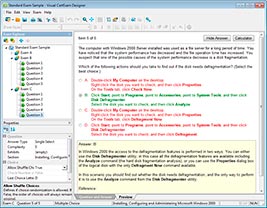
HOW TO OPEN VCE FILES
Use VCE Exam Simulator to open VCE files
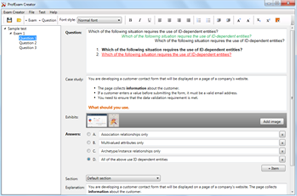
HOW TO OPEN VCEX AND EXAM FILES
Use ProfExam Simulator to open VCEX and EXAM files
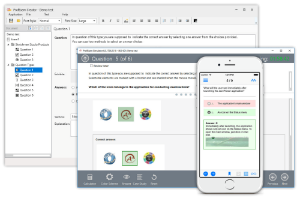
ProfExam at a 20% markdown
You have the opportunity to purchase ProfExam at a 20% reduced price
Get Now!