Download AWS Certified SysOps Administrator - Associate.SOA-C02.ExamTopics.2026-07-23.928q.vcex
| Vendor: | Amazon |
| Exam Code: | SOA-C02 |
| Exam Name: | AWS Certified SysOps Administrator - Associate |
| Date: | Jul 23, 2026 |
| File Size: | 8 MB |
How to open VCEX files?
Files with VCEX extension can be opened by ProfExam Simulator.
Discount: 20%

Demo Questions
Question 1
An organization is using cost allocation tags to find the cost distribution of different departments and projects. One of the instances has two separate tags with the key/ value as "InstanceName/HR", "CostCenter/HR". What will AWS do in this case?
- InstanceName is a reserved tag for AWS. Thus, AWS will not allow this tag
- AWS will not allow the tags as the value is the same for different keys
- AWS will allow tags but will not show correctly in the cost allocation report due to the same value of the two separate keys
- AWS will allow both the tags and show properly in the cost distribution report
Correct answer: D
Explanation:
AWS provides cost allocation tags to categorize and track the AWS costs. When the user applies tags to his AWS resources, AWS generates a cost allocation report as a comma-separated value (CSV file. with the usage and costs aggregated by those tags. Each tag will have a key-value and can be applied to services, such as EC2, S3, RDS, EMR, etc. It is required that the key should be different for each tag. The value can be the same for different keys. In this case since the value is different, AWS will properly show the distribution report with the correct values.
Question 2
Which of the following terms is NOT a key CloudWatch concept?
- Namespaces
- Units
- Time Stamps
- Indexes
Correct answer: D
Explanation:
The terminology and concepts that are central to one's understanding and use of Amazon Cloud-Watch are as follows: metrics, namespaces, dimensions, timestamps, units, statistics, periods, aggre-gation, alarms, and regions.Reference:http://docs.aws.amazon.com/AmazonCloudWatch/latest/DeveloperGuide/cloudwatch_concepts.html
Question 3
Network ACLs in a VPC operate at the ______.
- TCP level
- instance level
- subnet level
- gateway level
Correct answer: C
Explanation:
Security Groups in VPC operate at the instance level, providing a way to control the incoming and outgoing instance traffic. In contrast, network ACLs operate at the subnet level, providing a way to control the traffic that flows through the subnets of your VPC.Reference:http://docs.aws.amazon.com/AmazonVPC/latest/UserGuide/VPC_Security.html
Question 4
Which of the following statements is NOT true of CloudWatch?
- CloudWatch can be accessed using the AWS SDKS.
- CloudWatch can be accessed using the AWS console.
- CloudWatch can be accessed using CloudWatch API.
- CloudWatch can be accessed using the CloudWatch CLI for iOS.
Correct answer: D
Explanation:
AWS Cloudwatch can be accessed from the Amazon CloudWatch Console, CloudWatch API, AWS CLI and AWS SDKs.Reference:http://docs.aws.amazon.com/AmazonCloudWatch/latest/DeveloperGuide/accessing_cloudwatch.html
Question 5
A user creates an Auto Scaling group from the Amazon AWS Console and assigned a tag with a key of "environment" and a value of "Prod". Can the user assign tags to instances launched in the Auto Scaling group, to organize and manage them?
- Yes, this is possible only if the tags are configured at the launch configuration with a maximum length of 300 characters.
- Yes
- Yes, this is possible only if the tags are in the same AZ and the tag names are uppercase.
- No
Correct answer: B
Explanation:
You can organize and manage your Auto Scaling groups by assigning your own metadata to each group in the form of tags. You specify a key and a value for each tag. A key can be a general cate-gory, such as "project", "owner", or "environment", with specific associated values.By default, the instance will have a tag with the key as "aws:autoscaling:groupName" and the value as the name of the group.Reference:http://docs.aws.amazon.com/AutoScaling/latest/DeveloperGuide/ASTagging.html
Question 6
Which of the choices below best describes what Auto Scaling is well suited for?
- only for applications that experience hourly, daily, or weekly variability in usage.
- Both for applications that have stable demand patterns and that experience hourly, daily, or weekly variability in usage.
- Both for applications that use frameworks and SDKs to enhance its customer relationship.
- only for applications with a stable usage pattern but extremely high workload.
Correct answer: B
Explanation:
Auto Scaling is well suited to both applications that have stable demand patterns and that experi-ence hourly, daily, or weekly variability in usage. Whether the demand is predictable or unpredicta-ble auto scaling can be a good choice. If the demand is predictable and long term you may choose reserved instances. If the demand is unpredictable you may choose on-demand or even spot instance (if you can afford to have an instance lost unexpectedly).Reference:http://aws.amazon.com/autoscaling/
Question 7
What is Amazon Import/Export?
- A properly configured service role and instance profile
- An international shipping division to help you enhance your sales reach
- A service that accelerates transferring large amounts of data into and out of AWS using physical storage appliances
- A software developed by Amazon to migrate the data from/to your datacenter to AWS
Correct answer: C
Explanation:
AWS Import/Export accelerates transferring large amounts of data between the AWS cloud and portable storage devices that you mail to us. AWS transfers data directly onto and off of your stor-age devices using Amazon high-speed internal network.Reference:http://docs.aws.amazon.com/AWSImportExport/latest/DG/whatisIE.html
Question 8
What does enabling a sticky session with ELB do?
- Routes all the requests to a single DNS
- Ensures that all requests from the user's session are sent to multiple instances
- Binds the user session with a specific instance
- Provides a single ELB DNS for each IP address
Correct answer: C
Explanation:
By default, a load balancer routes each request independently to the registered instance with the smallest load. However, you can use the sticky session feature(also known as session affinity), which enables the load balancer to bind a user's session to a specific instance. This ensures that all requests from the user during the session are sent to the same instance.Reference:http://docs.aws.amazon.com/ElasticLoadBalancing/latest/DeveloperGuide/elb-sticky-sessions.html
Question 9
Amazon EC2 provides virtual computing environments known as _____.
- instances
- volumes
- microsystems
- servers
Correct answer: A
Explanation:
Amazon EC2 provides virtual computing environments known as instances. When you launch an instance, the instance type that you specify determines the hardware of the host computer used for your instance. Each instance type offers different compute, memory, and storage capabilities and are grouped in instance families based on these capabilities. Select an instance type based on the re-quirements of the application or software that you plan to run on your instance.Reference:http://docs.aws.amazon.com/AWSEC2/latest/UserGuide/concepts.html
Question 10
A corporate website is hosted on several Amazon EC2 instances across multiple regions around the globe.
How should an Administrator configure the website to maintain high availability with minimal downtime if one of the regions has network connectivity congestion for an extended period of time?
- Create an Elastic Load Balancer in front of all the Amazon EC2 instances.
- Create an Elastic Load Balancer that fails over to the secondary site when the primary site is not reachable.
- Create an Amazon Route 53 Latency Based Routing Record Set that resolves to an Elastic Load Balancer in each region. Set an appropriate health check on each ELB.
- Create an Amazon Route 53 latency Based Routing Record Set that resolves to Elastic Load Balancers I each region and has the Evaluate Target Health flag set to "true".
Correct answer: D
Explanation:
Reference:https://docs.aws.amazon.com/Route53/latest/DeveloperGuide/dns-failover-complex-configs.html
Question 11
A user has created a VPC with two subnets: one public and one private. The user is planning to run the patch update for the instances in the private subnet. How can the instances in the private subnet connect to the Internet?
- Use the internet gateway with a private IP
- Allow outbound traffic in the security group for port 80 to allow internet updates
- The private subnet can never connect to the internet
- Use NAT with an elastic IP
Correct answer: D
Explanation:
A Virtual Private Cloud (VPC) is a virtual network dedicated to the user's AWS account. A user can create a subnet with VPC and launch instances inside that subnet. If the user has created two subnets (one private and one public., he would need a Network Address Translation (NAT) instance with the elastic IP address. This enables the instances in the private subnet to send requests to the Internet (for example, to perform software updates).
HOW TO OPEN VCE FILES
Use VCE Exam Simulator to open VCE files
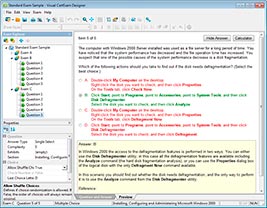
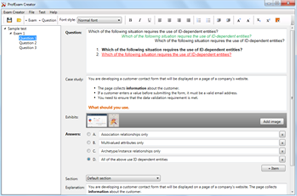
HOW TO OPEN VCEX AND EXAM FILES
Use ProfExam Simulator to open VCEX and EXAM files
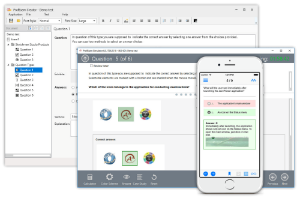
ProfExam at a 20% markdown
You have the opportunity to purchase ProfExam at a 20% reduced price
Get Now!